How Much Economic Theory Does the LSESU Essay Actually Need? An IB / A-Level Toolkit (2026)
Less than you fear — and more precisely than you expect. The LSESU Economics Society essay does not require university-level models: a well-applied IB or A-Level toolkit, deployed with stated assumptions and honest limitations, consistently outperforms name-dropped advanced theory. What the 100-point rubric rewards is analysis — using a model to generate an insight the reader did not already have — not vocabulary. This guide maps the school-level tools that fit the 2026 questions and shows the three-move pattern for deploying any of them in 1,500 words.
The misconception that sinks strong students
Every season we see the same pattern among China-based international-school entrants: students who are near the top of their IB HL Economics or A-Level class assume the competition demands DSGE models, Solow growth accounting, or graduate labour econometrics — so they either spend July trying to teach themselves university material, or they conclude the competition “isn’t for them” and never enter.
Both reactions misread what the questions ask. The five 2026 prompts are written by LSE faculty (the full wording and the marking rubric are in our prompts and rubric guide), and they are deliberately framed so that a thoughtful sixth-former can engage with them: remote work and monitoring, monetary policy after an energy shock, AI and jobs, taxing top earners, green technology and inequality. Each of these is analysable — genuinely, not superficially — with concepts on the IB and A-Level syllabus. The differentiator is precision of application, not altitude of theory.
A borrowed university model applied loosely fails in a specific, visible way: the essay describes the model instead of using it, spends 300 words on setup, and never connects the machinery back to the question. Markers see this instantly. A supply-and-demand argument with clearly stated assumptions, one honest limitation, and a concrete piece of evidence does more analytical work per word — and in a 1,500-word essay, work per word is the whole game.
The school-level toolkit, mapped to the 2026 themes
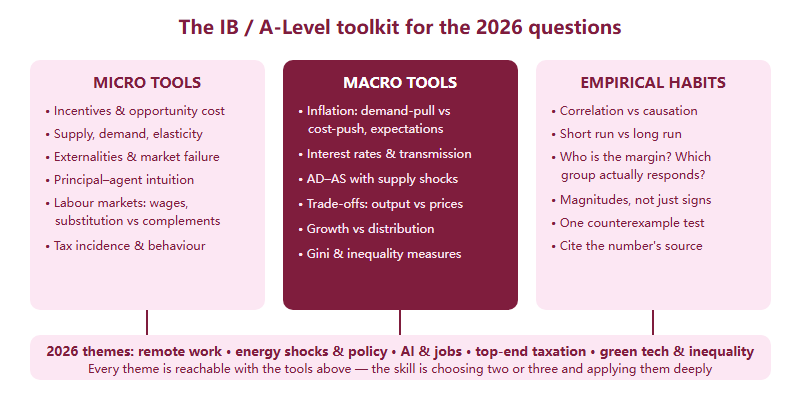
Here is how the toolkit meets each 2026 theme in practice. These are starting points, not templates — the rubric’s heaviest-weighted criterion rewards original thinking, so treat the pairings below as raw material.
| 2026 question theme | Core school-level tools that fit | One analytical trap to avoid |
|---|---|---|
| Remote work, workers and monitoring | Principal–agent intuition; incentives; labour supply and worker preferences as compensating differentials | Arguing only from personal or family experience with no framework behind it |
| Monetary policy after an energy shock | Cost-push vs demand-pull inflation; AD–AS with a supply shock; the output–inflation trade-off; expectations | Treating the central bank as if it can offset a supply shock costlessly |
| AI, jobs and inequality | Substitutes vs complements in labour demand; elasticity of demand for skills; short run vs long run adjustment | Extrapolating one dramatic anecdote into an economy-wide claim |
| Taxing top earners | Tax incidence; behavioural responses at the margin; equity–efficiency trade-off; Gini as a measuring stick | Assuming the statutory payer is the economic payer |
| Green technology and inequality | Externalities and correction; who bears transition costs; distribution of gains from innovation | Evaluating a policy’s average effect while ignoring who is at the losing margin |

The three-move pattern: how to deploy any model in under 200 words
The difference between “mentioning” theory and “using” it is a repeatable pattern. For each analytical tool you bring in, run three moves:
- Move 1 — State the assumption that makes the tool bite (1–2 sentences). “If employers cannot observe effort directly, pay must do work that monitoring used to do.” You have now told the marker exactly which lever your model turns.
- Move 2 — Run the mechanism to a non-obvious conclusion (3–5 sentences). Walk the causal chain step by step and land somewhere the reader could not have reached by common sense alone. This is where analysis marks live.
- Move 3 — Concede the limitation honestly (1–2 sentences). “This assumes workers can switch jobs freely; where they cannot, the effect weakens.” A stated limitation is not a weakness — it is evidence you understand the model’s boundary, which is precisely what distinguishes analysis from recitation.
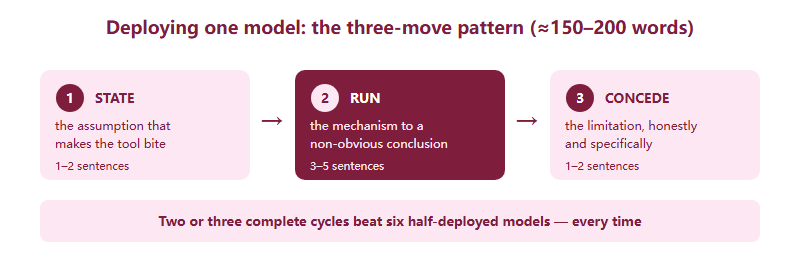
At 150–200 words per cycle, a 1,500-word essay has room for two or three complete deployments plus an introduction, a counterargument, and a conclusion. That arithmetic — which we develop further in our structure and method guide — is the real reason breadth fails: six models at 80 words each means six Move 1s and no Move 2s.
When advanced theory does help — and how to earn it
None of this means university material is forbidden. If you have genuinely worked through, say, a simple search-and-matching intuition for labour markets or read a central bank’s own explanation of transmission lags, a light-touch reference can strengthen an essay. The test is ownership: could you explain the idea to a classmate in your own words, and does it change your conclusion? If yes, use it — in one or two sentences, cited. If it appears only to signal sophistication, cut it. The competition screens submissions for plagiarism and AI-generated text, and unowned theory is also where paraphrase-without-understanding tends to creep in.
A safer route to sophistication is reading what the question-setters themselves have written for general audiences. The 2026 questions come from named LSE faculty, and their public lectures, interviews and columns are accessible to school students. Engaging with the actual author’s argument — even to disagree with part of it — reads as far more advanced than importing an unrelated model, and it grounds your essay in the exact debate the question came from.
A 60-minute self-test before you draft
Before committing your outline, run this diagnostic. For the question you have chosen (new to the competition? — start with What Is the LSESU Essay Competition?):
- Write down the two or three tools you plan to use. If you listed more than three, cut to three now.
- For each tool, write Move 1 (the assumption) in one sentence without opening a textbook. If you cannot, you do not own the tool yet — spend an evening with your syllabus notes before drafting.
- For your main tool, write the non-obvious conclusion it generates. If your conclusion is something any newspaper reader would already believe (“AI will change jobs”), the tool is not doing analytical work yet — push the mechanism one step further: which jobs, through which channel, over what horizon?
- Name one piece of real-world evidence per tool, with a source you can cite. Analysis without evidence and evidence without analysis both leave rubric points on the table.
Pass all four checks and you are ready to draft — with a toolkit you already own.
Frequently asked questions
Do I need university-level economics to win an LSESU essay award?
No. The rubric rewards precise application and original argument, not advanced machinery. Well-deployed IB or A-Level tools with stated assumptions and honest limitations compete strongly.
How many economic models should a 1,500-word essay use?
Two or three, deployed fully — assumption, mechanism, limitation — at roughly 150–200 words each. Six half-explained models signal coverage anxiety, not analysis.
Is it bad to use a basic supply-and-demand argument?
Not at all, if it generates a non-obvious conclusion. A basic model run carefully to a specific insight scores better than an advanced model described but never applied.
Can I cite the LSE professor who set my question?
Yes — engaging with the question-setter's public work is a strong move, including reasoned disagreement. Cite it properly and keep the focus on your own argument.
Published by the editorial desk of this site, operated independently by Hanlin International Education (翰林国际教育) for China-based international-school students. This site is not the official competition website and is not affiliated with the LSESU Economics Society or the London School of Economics. Official rules are set by the competition and change yearly, so always confirm current details on the official site lsesuesec.org. Confirmed errors are corrected within 7 working days.