The Final Edit: A Three-Pass Redraft and Pre-Submission Checklist for Your LSESU Essay (2026)
The final edit is where LSESU essays gain or lose the most marks per hour invested. With the 1 September 2026 deadline (23:59 GMT+1) inside seven weeks, a finished draft should now go through three distinct passes — an argument audit, an evidence and referencing pass, and a line edit — in that order, never mixed. This guide gives you each pass as a checklist, plus the compliance checks to run before you upload to the official portal, because a submitted essay cannot be revised or replaced.
Why editing passes must be separated — and sequenced
Most students “edit” by rereading the essay from the top and fixing whatever they notice: a comma here, a weak sentence there, occasionally a paragraph moved. This feels productive but systematically under-delivers, because it polishes sentences that a proper structural edit would delete. Among the drafts we review from China-based international-school students each season, the single most common pattern is a beautifully polished second paragraph that should not exist at all.
The fix is sequencing. Structural problems (argument) are fixed first, because they change what text survives. Substantiation problems (evidence, referencing) come second, because they change what claims survive. Surface problems (clarity, grammar, word count) come last, because there is no point line-editing a sentence you might cut. Three passes, roughly one week each if you are starting now — or three focused days if you are closer to the deadline.
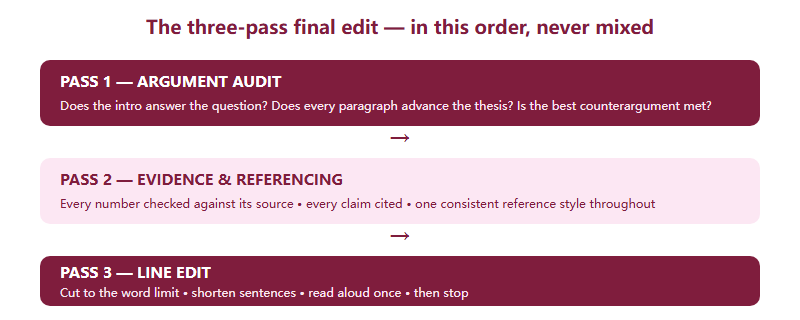
Pass 1: the argument audit
Print the essay or open it on a second screen, and answer these questions in writing — not from memory, but by pointing at the exact sentences:
- Where is your answer? Your direct answer to the question should be visible in the opening paragraph, not held back for a “reveal” in the conclusion. Markers reading many essays reward writers who commit early.
- Can you reconstruct the skeleton? Write one sentence per paragraph stating its job. If two paragraphs have the same job, merge them. If a paragraph’s job is “background”, it is usually the first candidate for deletion — a 1,500-word essay has no room for throat-clearing.
- Is the strongest objection inside the essay? Not a strawman — the objection a smart opponent would actually raise. Meeting it, conceding part of it, and explaining why your thesis survives is one of the clearest markers of first-class analysis. If your counterargument section defeats its opponent too easily, you picked the wrong opponent.
- Does the conclusion add anything? A conclusion that only restates is dead weight. Strong conclusions state the answer’s boundary: under what conditions would you change your mind?
If Pass 1 reveals a structural problem, fix it by rewriting sections, not by inserting patch sentences. Our structure and method guide covers what each section owes the overall argument, and the marking criteria you are auditing against are broken down in the 2026 prompts and rubric guide.
Pass 2: evidence and referencing
This pass is mechanical, which makes it easy — and easy to skip. Do not skip it: referencing carries dedicated weight in the 100-point rubric, and it is the cheapest place on the entire mark sheet to avoid losing points.
- Re-verify every number against its original source. Not against your notes — against the source. Statistics mutate as they pass through summaries, and a marker who spots one wrong figure will doubt every other figure in the essay.
- Check that every empirical claim has a citation, and every citation has a claim. Orphan references padding the bibliography are as visible as uncited claims.
- Use one referencing style consistently. The official guidance recommends Harvard referencing; whatever style you use, apply it identically everywhere — confirm current formatting requirements on lsesuesec.org rather than copying a friend’s format.
- Audit your paraphrasing. Anywhere your sentence tracks a source’s sentence too closely, rewrite it from your own understanding. The competition screens entries for plagiarism and AI-generated text, and entries that fail integrity checks face disqualification. Your protection is simple: every sentence in your own words, every borrowed idea credited.

Pass 3: the line edit — especially for non-native writers
Only now do you polish prose. For students writing in English as a second or third language, three edits deliver most of the gain:
- Halve your longest sentences. Find every sentence over roughly 30 words and split it. Complexity should live in your ideas, not your syntax — LSE-style academic writing prizes clarity, and short sentences expose weak logic, which is exactly what you want before a marker sees it.
- Replace abstraction chains with agents and actions. “The implementation of monitoring technologies has implications for compensation structures” becomes “When firms monitor workers more closely, pay tends to change in two ways…”. Who does what to whom — economics prose is at its best when the causality is visible in the grammar.
- Cut intensifiers and hedges that do no work. “Very”, “extremely”, “it could perhaps be argued that” — each deletion buys back words for analysis. This is also where you land the word count: the limit is roughly 1,500 words, and disciplined cutting at sentence level is how you get there without amputating an argument (confirm the exact counting rules in the official guide).
Finish the pass by reading the essay aloud once, end to end. It is the cheapest proofreading technology ever invented: your ear catches what your eye forgives.
The compliance checklist: run this before you upload
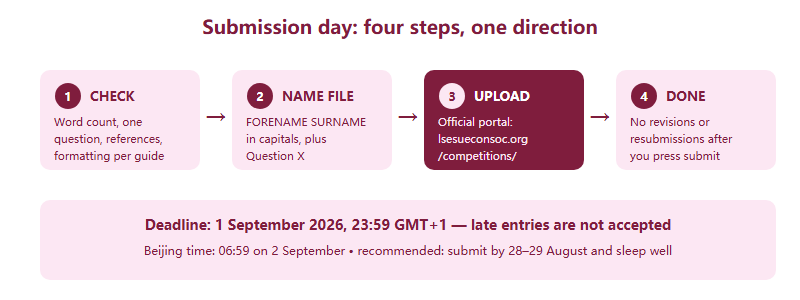
The LSESU competition has an unusually light administrative footprint — no registration, no candidate ID, prompts public all season (if you are new here, start with the competition overview). That lightness concentrates all the compliance risk into one moment: submission. Run every row of this table before you upload.
| Check | Detail | Why it matters |
|---|---|---|
| One question, one essay | Your essay answers exactly one of the five 2026 questions; you submit only once | Multiple or duplicate entries are not permitted |
| Word limit | At or under the roughly 1,500-word limit; confirm counting rules in the official guide | Over-length essays risk penalties — do not gamble on tolerance |
| File naming | Your name in capitals plus the question number: FORENAME SURNAME, Question X | The official guidance specifies this format so entries can be processed correctly |
| Formatting | Follow the official formatting guidance (font, spacing, page numbers) as published on lsesuesec.org | Formatting requirements are set by the competition and can change yearly |
| References complete | One consistent style; every claim cited; list finalised | Referencing is a scored criterion — free marks if done, free losses if not |
| Integrity | All your own writing; no AI-drafted text; sources credited | Entries are screened; violations risk disqualification |
| Submission channel | Upload via the official portal at lsesueconsoc.org/competitions/ | This is the only submission route — no email entries |
| Timing | Submit days early; deadline is 1 Sep 2026, 23:59 GMT+1 (06:59 on 2 Sep, Beijing time); late entries not accepted | You cannot revise after submitting, but you also cannot submit after the deadline — early beats last-minute |
Knowing when to stop
There is a point — usually after the third pass — where further editing starts moving marks sideways rather than upward: you swap synonyms, reorder clauses, and second-guess a thesis that was fine yesterday. Two signs you have reached it: your edits today reversed edits from yesterday, and you can no longer say what a change improves in rubric terms. When both are true, run the compliance checklist, name the file, and submit. An essay that has survived an argument audit, a source verification, and a read-aloud line edit is ready — and submitting in late August, rather than at 23:58 GMT+1, is itself the final quality decision.
Frequently asked questions
How long should the final edit of an LSESU essay take?
Plan three passes — argument, evidence, line edit — of a few focused hours each. Spread over one to three weeks, that is far more effective than a single marathon rereading session.
Can I edit or resubmit my essay after uploading it?
No. Submissions cannot be revised or replaced once made, and each entrant submits one essay on one question. Complete every check before you upload, not after.
What should the file be called when I submit?
The official guidance asks for your name in capitals plus your question number — FORENAME SURNAME, Question X. Confirm the current requirement on lsesuesec.org before uploading.
Is using AI to polish my grammar allowed?
Entries are screened for AI-generated text and integrity violations risk disqualification. The safe standard is that all wording is your own; for grammar, use your own read-aloud pass and a human proofreader such as a teacher.
Published by the editorial desk of this site, operated independently by Hanlin International Education (翰林国际教育) for China-based international-school students. This site is not the official competition website and is not affiliated with the LSESU Economics Society or the London School of Economics. Official rules are set by the competition and change yearly, so always confirm current details on the official site lsesuesec.org. Confirmed errors are corrected within 7 working days.