The LSESU Essay Competition Final-Month Plan: A Week-by-Week Revision Roadmap to 1 September 2026
With the LSESU Economics Society Essay Competition deadline set for 1 September 2026 at 23:59 GMT+1, you likely have around six weeks left — and the highest-value use of that time is not more drafting, but disciplined revision. This roadmap splits your final month into four focused passes, from big structural edits down to the last proofread, so your essay arrives polished rather than rushed.
Treat the final stretch as a revision project, not a drafting sprint
By late July, most competitive entrants already have a full draft. That is exactly why marks now separate on revision, not on fresh ideas. A first draft gets your argument onto the page; a fourth draft is what a marker actually rewards. The published mark scheme spreads across several criteria — originality, relevance, structure, clarity, referencing and depth of argument — and nearly every one of them improves under editing rather than under more writing. You can see how the criteria fit together in our breakdown of the 2026 prompts and rubric.
The mental shift is simple but hard: stop adding, start subtracting and sharpening. Resist the urge to research one more paper or bolt on another section. With a fixed word limit of roughly 1,500 words (confirm the exact figure on the official site), every sentence you add now forces another one out — so the essay improves fastest when you make the words you already have work harder. Treat the next month as a project with stages, not an open-ended sprint, and you will submit something deliberate instead of something patched together in the small hours of deadline day.
The four-week revision roadmap at a glance
The plan below moves from the biggest, hardest-to-fix problems (does the essay answer the question?) to the smallest (is that comma right?). Fixing structure last is a classic mistake: you end up proofreading sentences you later delete. The dates are approximate — compress or stretch them to fit your own schedule, but keep the order.
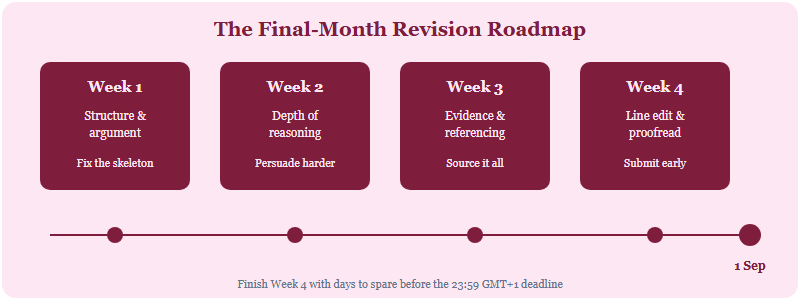
| Week | Focus | Key actions | You finish with |
|---|---|---|---|
| Week 1 | Structure & argument | Reverse-outline every paragraph; confirm the essay answers one question directly; cut or merge weak sections | A skeleton that holds |
| Week 2 | Depth of reasoning | Stress-test each claim; add the mechanism behind it; answer the strongest counter-argument | An argument that persuades |
| Week 3 | Evidence & referencing | Verify every fact and figure; format citations in Harvard style; confirm data is current and attributed | Clean, sourced evidence |
| Week 4 | Line edit & proofread | Trim to the word limit; read aloud; fix grammar; format and name the file; submit early | A submitted, polished essay |
Weeks 1 and 2 — repair the argument and the structure
Start with the single most powerful editing tool: the reverse outline. Read your draft and, next to each paragraph, write one short sentence stating what that paragraph does for your argument — not what it is about, but what job it performs. When you line those sentences up, three problems jump out: paragraphs that do the same job twice, paragraphs that do no job at all, and a running order that does not build. Delete, merge and reorder until the outline reads like a logical case a marker could follow blind.
Then interrogate the thesis. In one sentence, what are you actually arguing, and does it answer the chosen question head-on? Relevance is a marking criterion, and the most common way strong writers lose it is drifting into an adjacent, more comfortable question. In Week 2, move from “is it structured?” to “is it convincing?” For every key claim, ask: have I shown the mechanism, or only asserted a result? Have I acknowledged the best objection and answered it? This is where depth of argument is won. If you are still refining how the essay is built rather than how it is edited, revisit our guide on how to write the essay and fold its structure principles into your revision.
- Cut any paragraph whose reverse-outline sentence you cannot write clearly.
- Replace “X causes Y” assertions with “X causes Y because…” reasoning.
- Add one genuine counter-argument and a measured response to it.
- Make sure your introduction promises exactly what your conclusion delivers.

Week 3 — sharpen evidence, economics and referencing
A persuasive argument still fails if the evidence is vague or unsourced. Week 3 is a fact-and-source audit. Go claim by claim and ask two questions of each: is this accurate, and can a reader trace it? Every statistic, historical example and empirical result should point to a credible source — a paper, an official dataset, a reputable institution — and each should be cited consistently. Replace rounded-from-memory figures with checked ones, and delete any “studies show” claim you cannot actually attribute.
This is also the week to make your economics precise. Swap loose language for the correct concept: elasticity, marginal effects, opportunity cost, general versus partial equilibrium. Markers reward candidates who use theory as a scalpel, not as decoration. Referencing is itself a scored criterion, so budget real time to format your citations properly rather than leaving them for the final rushed hour.
- Confirm every number against a primary or official source, not a summary.
- Attribute each idea you borrowed; keep your own analysis clearly your own.
- Use one consistent referencing style throughout (Harvard is recommended — confirm on the official site).
- Prefer one well-explained example to three thinly asserted ones.
Week 4 — line edit, proofread and submit early
Now, and only now, work at the sentence level. Editing order matters because polishing prose before the structure is settled wastes effort on words you may cut. Move from macro to micro in the sequence below, saving the true mechanics — spelling, word count and formatting — for last.
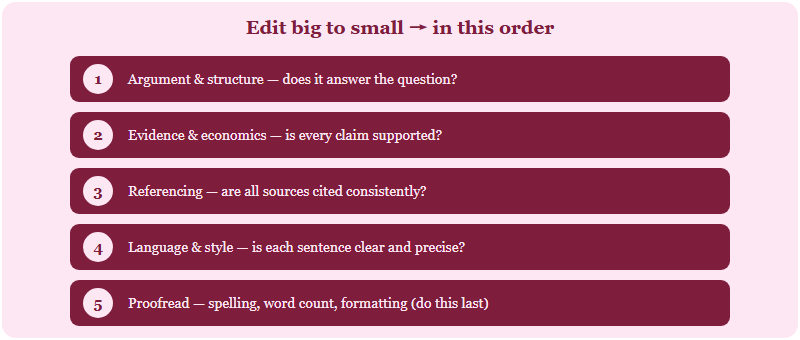
Read the whole essay aloud once — your ear catches clumsy sentences your eye skims past. Trim ruthlessly to the word limit; the tightest 1,500 words almost always beat the fullest. Then handle the mechanics: apply the recommended formatting, name your file correctly, and check the word count. Aim to upload with days in hand, because the LSESU essay cannot be revised or replaced once submitted — a fact you should treat as a hard rule, not a suggestion. For the current submission rules and prompt wording, keep the 2026 prompts and rubric open beside you as you finalise.
Your final-month self-check
Before you upload, run one honest pass against the criteria your essay will be judged on. If any answer is “not yet,” you have found your next edit.
| Criterion | Ask yourself |
|---|---|
| Relevance | Does every paragraph answer the one question I chose? |
| Structure | Can a reader follow my case from a reverse outline alone? |
| Depth of argument | Have I shown mechanisms and answered the best objection? |
| Evidence | Is each key claim backed by a cited source or dataset? |
| Clarity | Would a non-specialist grasp my thesis in one read? |
| Referencing | Are all sources in one consistent Harvard style? |
| Originality | Is the angle genuinely mine, not a summary of one paper? |
| Compliance | Am I within the word limit, formatted and named correctly? |
Frequently asked questions
How much time should I leave before the 1 September 2026 deadline?
Aim to finish editing about a week early. The essay cannot be revised once submitted, so a buffer lets you make final checks calmly rather than at 06:00 Beijing time.
Should I keep writing new sections in the final month?
Usually no. With a roughly 1,500-word limit, the biggest gains come from cutting and sharpening what you have, not adding more. Confirm the exact limit on the official site.
I have not started yet — is it too late?
Not necessarily, but move fast. Read what the LSESU Essay Competition is and the prompts, then compress this roadmap into your remaining weeks.
Does revising against the rubric really change my mark?
Yes. Structure, clarity and referencing all improve under editing, and each is a published marking criterion — see the 2026 rubric breakdown for how they combine.
Published by the editorial desk of this site, operated independently by Hanlin International Education (翰林国际教育) for China-based international-school students. This site is not the official competition website and is not affiliated with the LSESU Economics Society or the London School of Economics. Official rules are set by the competition and change yearly, so always confirm current details on the official site lsesuesec.org. Confirmed errors are corrected within 7 working days.