Two Weeks Out and Your LSESU Draft Isn't Working: A Salvage-or-Stop Triage (2026)
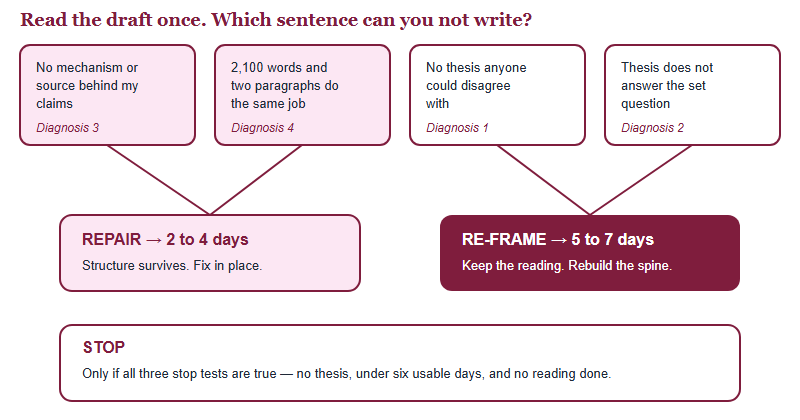
A draft that is not working has one of four problems, and each needs a different repair costing a different number of days. Polishing helps none of them. Before you spend your last fortnight editing sentences, spend one hour diagnosing which failure you actually have — and be willing to conclude that one of them is not worth fixing by 1 September.
This is triage, not polishing
There is a large difference between a draft that needs tightening and a draft that needs rebuilding, and students in late August routinely treat the second as if it were the first. They open the document, start at the top, and begin improving sentences. Two weeks later they have a beautifully written essay with the same structural fault it had at the start.
Triage inverts that. You read the whole draft once, at speed, and refuse to touch a single word. Your only job on that read is to identify which of four failures you have. Then you pick the repair that matches, and you do that repair and nothing else. Sentence-level editing is the last thing you do, if there is time, and it is worth fewer marks than you think.
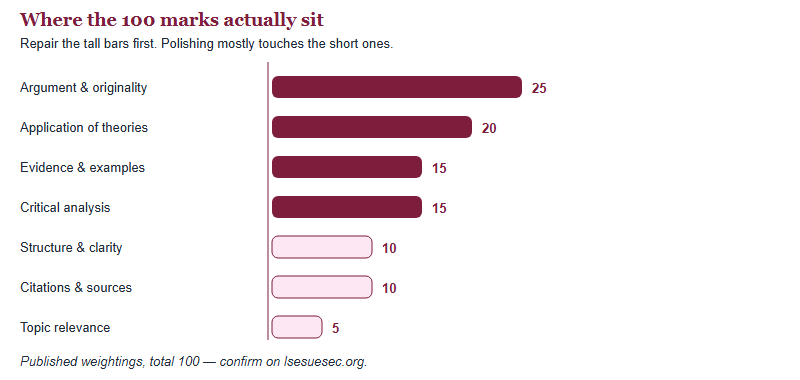
That last point is worth stating precisely, because the published criteria settle it. Argument and originality carries 25 marks. Application of economic theories carries 20. Evidence and examples, and critical analysis, carry 15 each. Structure and clarity carries 10, citations and sources 10, and topic relevance 5. The two things that respond to polishing — clarity and citation neatness — are worth 20 marks between them. The two things that respond only to rebuilding are worth 45.
The four diagnoses, each with a sixty-second test
Run all four tests. It is common to have two problems, in which case you fix the one higher up this list first, because the repairs below it may become unnecessary once it is done.
Diagnosis 1 — there is no argument. The test: write your thesis in one sentence, without looking at the draft, in a form a reasonable economist could disagree with. If what comes out is a topic (“this essay examines the effects of X”) rather than a claim (“X raises Y, because Z, and the usual objection fails because W”), you have the most common and most expensive failure. Everything downstream is description, and description does not score in the 25-mark band.
Diagnosis 2 — the argument does not answer the set question. The test: read the question you chose, then read your section headings in order, and for each one ask whether you can connect it to the question in a single step. If a section needs two steps of explanation to justify its presence, it is answering a question you invented rather than the one that was set. This is the failure that quietly costs you topic relevance and drags application of theory down with it, because your models are aimed at the wrong target.
Diagnosis 3 — claims without mechanism or source. The test: pick any three assertions at random and, for each, name the economic mechanism that produces it and the source that supports it. If you can do this for three out of three, you are fine. If you can do it for one, you have an essay of opinions. This failure sits directly on the 20 marks for application of theory and the 15 for evidence.
Diagnosis 4 — it is all there, but it is 2,100 words and shapeless. The test: list each paragraph's job in four words. If two paragraphs have the same job, or if any paragraph resists a four-word description, you have a compression problem rather than a thinking problem. This is the best failure to have in the final fortnight, because it is the only one that is purely mechanical.
What each repair costs, and what it is worth
The value of a repair is not how much better the essay feels afterwards. It is how many marks sit in the criterion the repair touches, multiplied by how far below the ceiling you currently are in it. That is why rebuilding an argument beats rewriting a bibliography even though the bibliography is far more satisfying to finish.
| Diagnosis | The repair | Criteria it moves | Marks in play | Realistic days |
|---|---|---|---|---|
| 1. No argument | Write one disagreeable sentence, then rebuild each section to serve it | Argument and originality; critical analysis | 40 | 5–7 |
| 2. Wrong target | Re-aim the same material at the question actually set | Topic relevance; application of theory | 25 | 4–6 |
| 3. No mechanism or source | For each claim, name the mechanism and attach one credible source | Application of theory; evidence and examples | 35 | 3–4 |
| 4. Over length, shapeless | One job per paragraph; delete duplicates; cut to the limit | Structure and clarity; relevance | 15 | 2–3 |
| None of the above | Sentence-level editing and reference formatting | Clarity; citations and sources | 20 | 1–2 |
Read that table alongside the actual weightings and the ordering becomes obvious.

The repair you should almost never attempt now
Switching to a different question from a standing start is the one move that reliably fails in the last fortnight. It resets your reading, your evidence and your argument simultaneously, and it feels productive precisely because everything is new again. Students reach for it when the real problem is Diagnosis 1, and a fresh question does not supply an argument any more than the old one did.
There is one narrow exception. If you had already done substantial reading for a second question earlier in the summer, and your current draft is short enough that abandoning it costs little, then switching is a re-frame rather than a restart, and the day estimates above apply. If either half of that condition is false, stay where you are and fix the argument. Our guide to the 2026 prompts and published criteria is a faster way to check what your current question is really asking than starting over on a different one.
The stop condition, stated honestly
Sometimes the right answer is not to submit this year, and an editorial desk that never says so is not being useful. Stop only if all three of these are true at once:
- You cannot state a thesis in one disagreeable sentence, even after an hour of trying with your notes in front of you.
- You have fewer than six usable working days before your personal cut-off — usable meaning days you actually control, not days that exist on a calendar alongside school, travel and other deadlines.
- The reading is not done. If you have read properly, you almost always have an argument hiding in your notes, and the honest diagnosis is Diagnosis 1 rather than a stop.
If only one or two are true, you are in repair or re-frame territory and you should get on with it. Notice that submitting a merely competent essay is not a failure condition. Entries are scored across seven criteria out of 100; a solid, on-question, properly sourced essay with a modest but genuine argument is a real entry, not a wasted one. Perfection is not the entry bar and never was.
And if you do stop, be clear about what stopping means. The reading stays. The note file stays. The habit of building an argument from evidence stays, and it transfers directly to school coursework, to an extended essay or research project, and to any interview where someone asks what you have been reading. What you are declining is one submission deadline, not the work. Students who stop cleanly in late August and keep their notes tend to start the following cycle from a much stronger position than students who submit something they did not believe in.
A ten-day plan for the most common case
Diagnosis 1 — no argument — is the one we see most often at this stage. Here is what the re-frame looks like when you have ten days and other commitments, ending at a personal cut-off on 31 August rather than at the deadline itself.
- Days 1–2. Do not open the draft. Working only from your notes, write the one disagreeable sentence, then write the strongest objection to it, then decide whether you can answer that objection. If you cannot, change the sentence, not the objection.
- Day 3. Build a section plan of five or six lines, each stating what that section proves and which piece of evidence proves it. This plan, not the old draft, is now the essay.
- Days 4–6. Write to the plan, taking passages from the old draft only where they fit the new spine. Expect to reuse less than half of it, and do not fight to save paragraphs you like.
- Day 7. Mechanism and source pass: every claim gets a named mechanism and an attribution.
- Day 8. Cut to 1,500 words, references excluded. One job per paragraph.
- Day 9. Clarity and references. This is the day the polishing you wanted to do on day one actually earns its marks.
- Day 10. Compliance checks, export, second device, submit. Then stop, because there is no revision route after you upload.
If you would rather see the same ten days from the drafting side than the diagnostic side, our guide to writing the 1,500-word essay sets out what each section is doing and why.
Frequently asked questions
Is it too late to change my question?
Almost always yes, unless you already did the reading for the other question earlier in the summer and your current draft is short.
My draft is 2,100 words. Is that a serious problem?
It is the easiest of the four failures to fix. The limit is 1,500 words excluding references, and cutting is mechanical work.
Should I submit an essay I am not proud of?
A solid, on-question, properly sourced essay with a genuine argument is a real entry. Perfection has never been the bar.
Can I fix it after submitting if I spot a problem?
No. There is no revision or replacement route, so every repair has to happen before you upload.
Published by the editorial desk of this site, operated independently by Hanlin International Education (翰林国际教育) for China-based international-school students. This site is not the official competition website and is not affiliated with the LSESU Economics Society or the London School of Economics. Official rules are set by the competition and change yearly, so always confirm current details on the official site lsesuesec.org. Confirmed errors are corrected within 7 working days.