Cutting to 1,500 Words: A Sentence-Level Compression Clinic for the Final Week (2026)
If your LSESU essay is 200 to 400 words over, the repair is almost never deleting a paragraph. The 2026 limit is 1,500 words excluding titles, subtitles and references, and in most drafts the overshoot sits in sentence construction rather than in ideas. This clinic shows where the words hide, which ten moves recover them, and which four sentences you must never cut to save space.
What the 1,500 actually counts — and why that changes your cut
The published 2026 guidance sets the limit at 1,500 words, excluding titles, subtitles and references. Confirm the current wording on lsesuesec.org before relying on any edge case, but as published, that exclusion has two practical consequences most students never use.
First, a subheading is free structure. A signposting sentence such as “This section will examine how monitoring interacts with intrinsic motivation” costs you twelve body words. A four-word subtitle above the same paragraph does the identical navigational job at zero cost against the limit. If you have three such sentences, converting them is a 30-to-40-word recovery that also reads better.
Second, stop economising on your reference list. References sit outside the count, so shortening entries, dropping page numbers or dropping a source to save space buys you nothing and costs you against Citations and sources, which carries 10 of the published 100 marks. The full criteria and their weights are set out in our guide to the 2026 prompts and the published marking criteria.
One warning, because that logic runs out fast. The exclusions exist for apparatus, not as a loophole. Pushing analysis down into footnotes, or padding a notes section with reasoning that belongs in your argument, is a bad-faith cut: a reader assessing structure and clarity is reading the body, and an argument that hides from its own word limit reads exactly as it is. Cut properly instead.
Before you start, fix your counting method. Word processors differ in whether they include headings, footnotes and captions by default, so select the body text only and count the selection. Write the starting number down. You cannot manage a cut you are not measuring.
Diagnose the overshoot before you cut anything
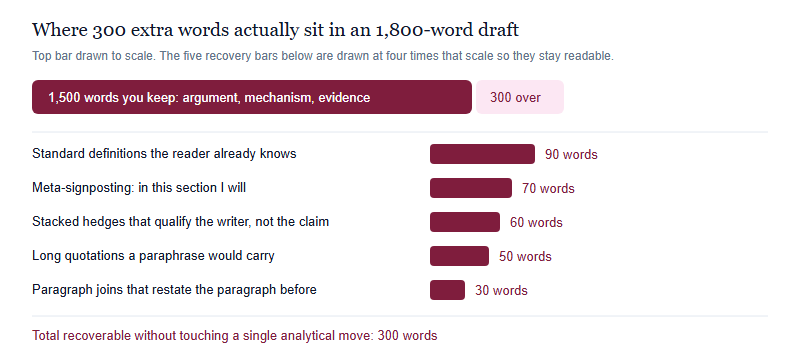
The size of the overshoot determines the method. Cutting 40 words and cutting 400 words are different jobs, and using the second method on the first problem is how good paragraphs die unnecessarily.
| Overshoot | What it means | Method | Time |
|---|---|---|---|
| Under 80 words | Normal drafting slack | Sentence surgery only. Nothing structural. | 45 min |
| 80–250 words | Slack plus one redundant element | Sentence surgery, then delete one definition or one quotation | 90 min |
| 250–450 words | One analytical move too many | Sentence surgery first, then cut your second example or second sub-argument, then re-read for broken joins | 2–3 hrs |
| Over 450 words | A scope problem, not a style problem | Narrow the claim you defend. You are answering more of the question than 1,500 words can hold. | Half a day |
If you land in the bottom row, the honest move is to re-read what your question actually asks and defend a narrower claim well rather than a broad one thinly. Our guide to writing the 1,500-word essay sets out how a single claim gets scoped to the length.

Ten sentence moves, and what each returns
These are the moves that recover words without removing thinking. Every example below is our own construction, written to resemble the sentences that appear in economics essays at this stage of a season.
| Move | Before | After | Saved |
|---|---|---|---|
| 1. Kill the empty opening | There is a strong case to be made that firms will underinvest in monitoring (14) | Firms will underinvest in monitoring (5) | 9 each |
| 2. Un-nominalise the verb | The implementation of monitoring by the firm led to a reduction in effort (13) | Monitoring reduced effort (3) | 10 each |
| 3. Shorten the connectives | due to the fact that; in order to; despite the fact that | because; to; although | 2–4 each |
| 4. Unstack the hedges | It could perhaps be argued that this may possibly reduce welfare (11) | This may reduce welfare (4) | 7 each |
| 5. Turn signposting into a subtitle | In this section I will examine the distributional effects (9) | Subtitle: Distributional effects (0 counted) | 9–14 each |
| 6. Delete the textbook definition | A 25-word definition of moral hazard or price elasticity | Use the term correctly in the sentence that needs it | 15–30 each |
| 7. Paraphrase the block quotation | A 30-word quoted passage plus citation | A 12-word paraphrase plus the same citation | 15–20 each |
| 8. Cut redundant pairs | each and every; reduce and lower; first and foremost | Keep one word | 2–3 each |
| 9. Stop restating the last paragraph | As discussed above, monitoring erodes trust. Given this, we now turn to (13) | Open with the new claim | 10–15 per join |
| 10. Delete adjectives carrying no economics | a very significant and highly important effect (7) | a large effect — or give the magnitude (3) | 4–6 each |
Run moves 1, 2 and 4 with your document search function rather than by reading. Search for “there is”, “there are”, “it is important”, “the fact that”, “could be argued” and “in terms of”. Reading hides these constructions, because they sound like academic writing. Searching does not.
Move 4 needs one caveat, because not all qualifiers are padding. Getting this wrong in either direction costs marks. Compare two sentences:
- Carries economics: “Monitoring may reduce effort where intrinsic motivation is high.” The qualifier states a condition. Delete it and the sentence becomes a claim you cannot defend and probably do not believe.
- Carries anxiety: “It could perhaps be suggested that monitoring might possibly reduce effort in some cases.” The qualifiers describe the writer, not the world. Delete them and you lose nothing but eight words.
The test is one question: if I remove this qualifier, does the sentence become wrong, or does it only become exposed? Wrong means keep. Exposed means cut. Across a full draft this single test typically recovers 40 to 90 words, and it improves the essay independently of length, because precise language sits inside the structure and clarity criterion. Students meeting this competition for the first time often over-hedge because the stakes feel high; if that is you, our overview of what the LSESU Essay Competition is is a useful calibration of what readers are actually looking for.
The four sentences you protect
Cutting under pressure has a predictable failure mode: the hardest paragraph goes first, because it is the most effortful to keep coherent. That paragraph is usually the one carrying the marks. Four sentence types are protected, and each is protected for a reason you can point to in the published criteria.
| Protected sentence | What it does | Criterion it serves | Marks in that criterion |
|---|---|---|---|
| The direct answer | States your position on the question as set, in one sentence | Argument and originality; relevance to topic | 25 and 5 |
| The mechanism | Names the causal chain — who responds to what, and how — that makes this economics rather than commentary | Application of theory | 20 |
| The counterargument and your reply | Puts the strongest opposing case and answers it | Critical analysis and evaluation | 15 |
| The limit of your evidence | Concedes what your data cannot show | Evidence and example; critical analysis | 15 and 15 |
From those weights the cutting hierarchy follows mechanically: cut apparatus before argument, examples before mechanisms, and the second example before the first. If two examples make the same point, one of them is 90 free words. If your only counterargument is 90 words, it stays and something else goes.
A two-hour cutting session, run in order
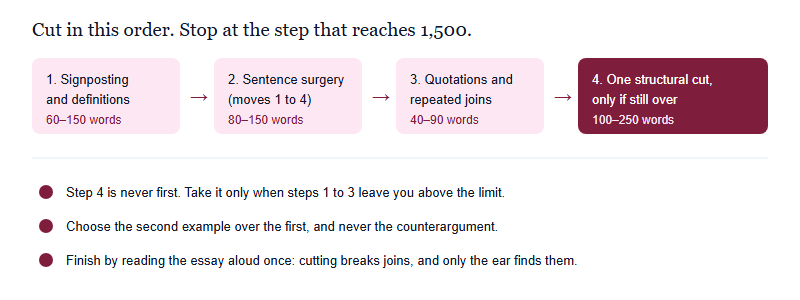
Time-box it: ten minutes to fix your counting method and record the starting number, twenty-five minutes on step one, thirty on step two, twenty-five on step three, twenty on step four if you need it, and the last ten reading aloud. The read-aloud is the step everyone skips and the one that catches the damage — a cut essay fails at the seams, where a deleted sentence took a logical connector with it.
One last discipline for the final week. Every cut is permanent in a way that matters this year: there is no revision or replacement route after you submit, so the version you upload is the version that gets read. Keep a dated copy of the draft before each cutting session. It costs nothing, and it means an over-aggressive hour on Thursday night does not silently become your entry.
Frequently asked questions
Do references count toward the 1,500 words?
No. The published 2026 guidance sets 1,500 words excluding titles, subtitles and references. Confirm edge cases on lsesuesec.org.
My essay is 1,530 words. Is 30 over really a problem?
Treat a limit as a limit. Thirty words is one nominalisation and two stacked hedges — fifteen minutes of work, not a risk worth carrying.
Can subheadings really save me words?
Subtitles sit outside the count as published, so a subheading can replace a signposting sentence. The argument itself still belongs in the body.
Should I cut my counterargument if I am over length?
No. Critical analysis carries 15 marks. Cut a definition, a quotation or a second example first, in that order.
Published by the editorial desk of this site, operated independently by Hanlin International Education (翰林国际教育) for China-based international-school students. This site is not the official competition website and is not affiliated with the LSESU Economics Society or the London School of Economics. Official rules are set by the competition and change yearly, so always confirm current details on the official site lsesuesec.org. Confirmed errors are corrected within 7 working days.