The Question-Type Audit: Does Your LSESU Essay Actually Answer What Was Asked? (2026)
With roughly a day left before the 1 September deadline, the highest-value check remaining is not stylistic. It is whether your essay delivers the thing your chosen question actually asks for. Relevance carries only 5 of the published 100 marks, but a question-type miss quietly weakens the argument, theory and critical-analysis marks as well — and unlike prose quality, it is checkable in under an hour.
Why this is the last check worth doing
Most last-day advice is about polish: cut words, fix citations, verify figures. Those are worth doing and we have written about each of them. But they all assume the essay is aimed at the right target. If it is not, an afternoon of polishing improves a document that a marker will read as slightly off-question — and that judgement, in our experience of reading drafts, forms in the first two paragraphs, before any of your polish is visible.
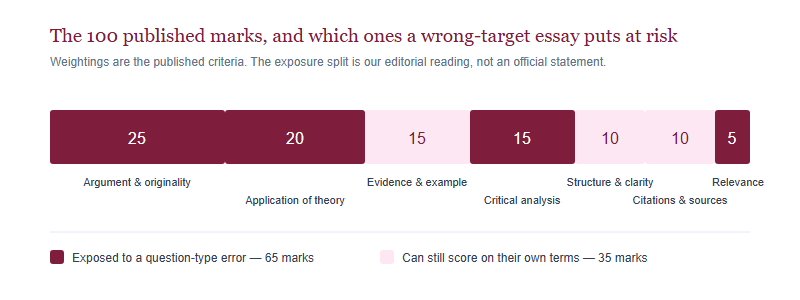
The published criteria make the exposure clear. Relevance to topic is worth 5 marks and rewards an essay that “directly answers the question asked”. That is the visible cost. The invisible cost is larger. Argument and originality (25 marks) rewards a logically consistent argument — but an argument aimed at a question nobody asked is consistent in a vacuum. Application of theory (20 marks) rewards models used “correctly and effectively”, and effectiveness is measured against the task. Critical analysis and evaluation (15 marks) rewards engagement with trade-offs and counterarguments — and if you never commit to a recommendation, there is nothing for a counterargument to push against.
On our reading of how those criteria interact, that is 65 of the 100 marks with some exposure to a single upstream error. The full criterion weightings and the official wording are published by the competition, and are set out alongside the questions below.
Every 2026 prompt is a task, not a topic
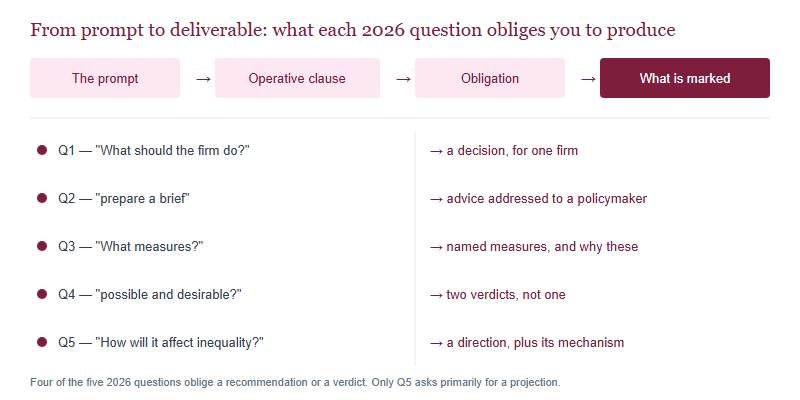
Read the five questions again and notice what they have in common. Not one of them names a topic and stops. Each contains an operative clause — a verb that tells you what kind of object you are being asked to produce. Four of the five oblige you to arrive at a recommendation or a verdict. Only one asks primarily for a projection.
This matters because students choose questions by topic (“I know about AI”, “I like monetary policy”) and then write about the topic. The marker is looking for the object the operative clause demanded. The table below strips each 2026 prompt down to that clause. The full wording of all five sits in our 2026 prompts and rubric guide; here we only need the operative part.
| 2026 question | Operative clause | What a complete answer must contain | The essay that misses it |
|---|---|---|---|
| Q1 — Pissarides (labour, home working and monitoring) | “What should the firm do…?” | A stated course of action for one firm, and the tension it resolves between what workers want and what the firm must protect | A survey of remote-work productivity findings, ending in “it depends” |
| Q2 — Reis (monetary policy after an energy price rise) | “prepare a brief for a central bank” | A recommendation written to a policymaker, bound by the stated mandate and the net-importer condition | An explanation of how energy prices feed into inflation, addressed to nobody |
| Q3 — Tenreyro (AI, jobs, inequality) | “What measures should be put in place…?” | Named measures, with a reason why these and not others, and ideally which comes first | A forecast of how many jobs AI will displace |
| Q4 — Van Reenen (taxing the top 1%) | “Is it possible and desirable…?” | Two verdicts — feasibility and desirability — answered separately, because they can diverge | A fairness argument that never tests whether the tax can actually be collected |
| Q5 — Gmeiner (climate-friendly technology and inequality) | “How will… affect inequality?” | A causal account with a stated direction and the mechanism producing it | A description of green technologies and a general worry about fairness |
Q4 deserves a moment on its own, because it is the one where the miss is almost invisible. “Possible and desirable” is two questions joined by a conjunction. Feasibility is an empirical question about behavioural responses, avoidance, mobility and administration. Desirability is a normative question about distribution and efficiency. An essay can be excellent on one and silent on the other, and read as complete to its own author, because it answered a question — just not the whole one.

Four ways a strong essay drifts off the task
These are not writing faults. Each of them is compatible with wide reading, correct economics and clean prose, which is exactly why they survive to the last day.
- The topic essay. You explain the subject thoroughly and never issue the object the verb demanded. Diagnostic: your conclusion summarises rather than decides.
- The half-answer. The prompt joins two demands and you complete one. Q4 is the obvious case, but Q3 also asks for measures that limit pay inequality “and, ideally, also in hours worked” — a second dimension most drafts drop entirely.
- The wrong addressee. Q1 asks what a firm should do; Q2 asks for a brief to a central bank. An essay that answers Q1 with a case for national labour regulation, or Q2 with advice to households, has changed who is acting. The economics may be sound; the task has been substituted.
- The undefended recommendation. You state a course of action in the final paragraph, having spent 1,400 words on background. Formally you answered. But the recommendation arrives with no room left to defend it, so the critical-analysis marks have nowhere to land.
The 45-minute audit
Do this on a printed copy or a second screen, not inside the document you might be tempted to edit as you go.
- Write the operative clause at the top of a blank page (2 minutes). Copy it from the official question, word for word. Not your paraphrase — paraphrase is where drift starts.
- Underneath it, write the object it demands in one line (3 minutes). “A decision for one firm.” “Two verdicts.” “Named measures, ranked.” If you cannot state the object in one line, that is the finding.
- Find that object in your essay and note the paragraph number (10 minutes). Not the theme — the sentence that is the object. If it appears only in the conclusion, note that. If it appears nowhere in a single sentence, note that too.
- Check the conditions the prompt attached (10 minutes). Several 2026 questions carry binding conditions inside them: a 2% inflation mandate and net energy importer status in Q2; workers who like the home day but dislike monitoring in Q1; hours as well as pay in Q3. List each condition and mark whether your essay uses it or merely mentions it.
- Read your introduction and conclusion back to back, nothing in between (10 minutes). In our experience, the relevance judgement forms largely from these two passages. If a reader could not tell from them alone what you are recommending, that is a bookend problem with a known fix — our structure and method guide covers how the opening should carry the claim.
- Write the verdict (10 minutes). One of three: on target, on target but late, or off target. Each has a different repair, and only one of them is worth touching the body of the essay for.
If it fails, with about a day left: three bounded repairs
The deadline is 23:59 GMT+1 on 1 September, which is 06:59 on 2 September in Beijing — so if you are reading this in China, plan to finish during the evening of 1 September rather than counting on the small hours. Submission is one-way: there is no revision or replacement after you upload. That constraint should make you conservative, not paralysed.
Match the repair to the verdict, and do only that:
| Verdict | The repair | Words it costs | What you must not do |
|---|---|---|---|
| On target | Nothing. Stop and go back to proofreading. | 0 | Do not manufacture a problem to justify a rewrite on the last day |
| On target but late — the object exists only in the conclusion | Move it. State the recommendation or verdict in the introduction, then let the body defend it. | Roughly 40–70, mostly recovered by deleting the throat-clearing you no longer need | Do not add a new section; you are relocating a sentence, not writing an argument |
| Off target — the second half of a two-part question is missing | Convert your weakest existing paragraph into the missing half. Choose the paragraph that is most descriptive. | Roughly 150–200, taken from that paragraph | Do not append the missing half to the end; a bolted-on verdict reads as an afterthought and costs the structure marks |
| Off target — wrong addressee, or a topic essay throughout | Reframe the opening and the conclusion around the correct actor and object, and change the topic sentence of each body paragraph so it points at that object. | Roughly 200–250, all in sentences you already have | Do not re-research. New sources at this stage introduce citation errors faster than they add value |
One caution about the largest repair. If your verdict is “off target throughout” and you have only a few hours, the honest question is whether a reframe you cannot finish carefully is better than a coherent essay that answers a slightly narrower question well. There is no published penalty for an imperfect entry, and the word limit of 1,500 words excluding titles, subtitles and references still applies to whatever you submit. Our own view is that a clean, complete essay that answers most of the question beats a half-executed reframe — but that judgement belongs to whoever is holding the draft.
Whichever repair you make, run a word count afterwards and re-export the PDF. Changing 200 words late is exactly the moment a document slips over the limit or picks up a formatting inconsistency, and the file you upload is the file that gets marked. If this competition is new to you, our overview of what the LSESU Essay Competition is sets out the entry basics in one place.
Frequently asked questions
Is relevance really only worth 5 marks?
Yes, 5 of the published 100. But an off-target essay also weakens the argument, theory and critical-analysis marks, where the real cost sits.
Can I change which question I am answering on the last day?
Practically, no. A new question means new reading, new theory and a new argument. Repair the essay you have rather than starting a second one.
Does the marker penalise me for answering only half of a two-part question?
The published criteria describe no specific penalty. But half an answer is an incomplete answer, and completeness is what relevance rewards.
What time does the deadline fall in China?
23:59 GMT+1 on 1 September is 06:59 on 2 September Beijing time. Treat the evening of 1 September as your real cut-off.
Published by the LSESU Essay Competition editorial desk, operated by Hanlin Education for China-based international-school students. Official rules are set by the competition and change yearly — confirm current details on lsesuesec.org. Errors are corrected within 7 working days.