You Missed the LSESU Deadline. What an Unsubmitted Economics Essay Is Still Worth in September
The 2026 window closed at 23:59 GMT+1 on 1 September — 06:59 on 2 September in Beijing — and the competition states that late submissions are not accepted. If you are holding an unsent draft this morning, the useful question is no longer how to enter. It is what the work you already did is worth, and what to do with it in the next four weeks.
What is actually true this morning
Three things, stated plainly so you are not chasing hope.
- The deadline was fixed and late entries are not accepted. There is no queue, no grace period we are aware of, and no candidate record to amend — entry never involved registration in the first place, which is precisely why there is nothing pending in your name.
- We do not publish exceptions, and neither should you assume one exists. If you experienced a genuine technical failure at the portal, the only place that can tell you anything is the competition's own official contact route on lsesuesec.org. Do not act on a summary of the rules — including ours.
- Nothing about missing it is visible to anyone. Because there is no registration, there is no record of an intended entry that failed to arrive. No school, university or future competition learns that you meant to enter and did not.
That last point matters more than it sounds. Students carry missed deadlines as though they were a mark on a record. This one is not on any record. What you have is a private inventory of half-finished work and a fairly precise diagnosis of your own writing process, which is worth more in September than most people realise.
Four ways to miss it — and why the fix differs
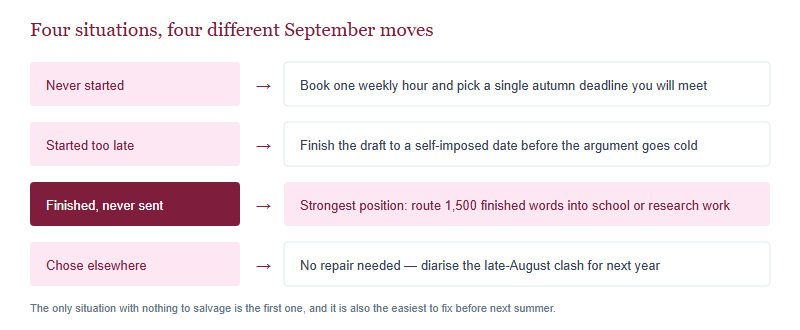
The right next move depends entirely on which of these you are. Be honest about it; the four situations have almost nothing in common except the date.
| How you missed it | What you are actually holding | The September move | What would have prevented it |
|---|---|---|---|
| Never started. You knew the competition existed and kept deferring the first hour. | Nothing written, but a live interest in economics that survived a whole summer | Skip the salvage question entirely. Go to the calendar section below and pick one autumn deadline you will actually meet. | A fixed weekly slot, not a plan. The first hour is the one that never gets scheduled. |
| Started too late. You began in mid or late August with real intent and ran out of runway. | Reading notes, a rough argument, possibly 600–900 words of draft | Finish it anyway, to a deadline you set this week. An unfinished argument decays fast; a finished one keeps. | Choosing a question two weeks earlier. Question churn is the most expensive habit in this competition. |
| Finished but never sent. The essay existed and something — a formatting problem, a network failure, an intention to do one more pass — stopped the upload. | A complete 1,500-word economics essay | The most valuable position of the four. Route it into school work or a longer research piece while it is still fresh. | Submitting several days early. The one-way nature of submission makes people wait, and waiting is the risk. |
| Chose elsewhere. You sent the essay to another competition instead. | An essay already committed somewhere, and a decision you made deliberately | Nothing to repair. Note the timing clash in your calendar for next year so the choice arrives earlier. | Nothing — a clash you resolve on purpose is not a miss. |

Where the words you already wrote can still go
A 1,500-word economics essay is a compressed research product. The compression is the expensive part, and you have already paid for it. Four destinations are worth considering, each with a gate you must pass first.
- A longer research piece at school. An EPQ, an IB extended essay or an internal assessment is often the same question with more room. This is usually the highest-value route, because the constraint you fought — 1,500 words — disappears and the reading you already did still counts. Gate: your school's own rules on reusing your own work. Ask your supervisor before you assume, because self-reuse policies differ by school and by qualification.
- Another competition. Possible, but never assume. Competitions publish their own conditions on originality, prior submission and simultaneous entry, and they genuinely differ from one another. Read the current rules on that competition's own official site before sending anything, and do not rely on any third-party summary, ours included.
- A school publication or economics society talk. Lower stakes, and it forces the same defence an interviewer would ask for. A fifteen-minute talk on your argument is worth more preparation value than a fourth redraft.
- Your own reading record. The papers you half-read in August are the ones you can now read properly. This is the least glamorous route and the one that pays over the longest horizon.
One thing not to do: keep polishing the essay as an artefact. It has no destination as a competition entry now, and editing it further is a way of not making a decision. Either route it somewhere with a real audience or archive it and move on.
Build your own autumn calendar from official sources
The natural next question is which competition to enter instead. We are deliberately not giving you a list, and the reason is practical rather than coy: essay competition dates, word limits and eligibility conditions change every cycle, and a list published in September is a liability by November. Students who plan from summaries end up with the wrong deadline in their diary. Build the calendar yourself, once, in about ninety minutes:
- Name your shortlist — four competitions, no more. Anything longer will not be maintained. Include at least one whose deadline falls in a term-time month, so your whole year does not depend on the summer again.
- Open each one's own official site and record five fields. Deadline with time zone; eligibility by school year; word limit and what it excludes; whether that competition requires registration or takes direct submission; and the rule on submitting the same work elsewhere. Copy from the official page, not from an article about it.
- Convert every deadline into your local time immediately. A deadline written in GMT+1 is not the date it appears to be if you are in Beijing — this year's 1 September cut-off was really a 2 September morning in China, and that seven-hour offset is easy to get wrong under deadline pressure.
- Put a personal deadline five days earlier in the same diary entry. The published deadline is a boundary, not a plan.
- Check the eligibility field against your school year for the cycle in question, not for today. The year group you are in when you write is often not the year group the rules refer to.
- Re-verify each entry once, four weeks before its deadline. Rules do change mid-cycle.
If the LSESU competition is on that shortlist for next year, our overview of what the competition is and how entry works is the right place to start, and the 2026 questions and marking rubric remain the best available guide to the kind of question that gets set — while remembering that the questions themselves change each year.
The post-mortem that makes next year different
Do this within a week, while you can still remember what actually happened. It takes twenty minutes and it is the single most useful thing available to you today.
Write down, honestly: the date you first read the questions; the date you settled on one question; the date you wrote your first real paragraph; and how many hours in total you spent. Then compare the shape of that against a workable allocation. The failure pattern we see most often is not laziness — it is inversion: weeks spent reading with no stopping rule, then drafting compressed into the final days, leaving nothing for revision, which in our coaching experience is where most of the marks are actually made.
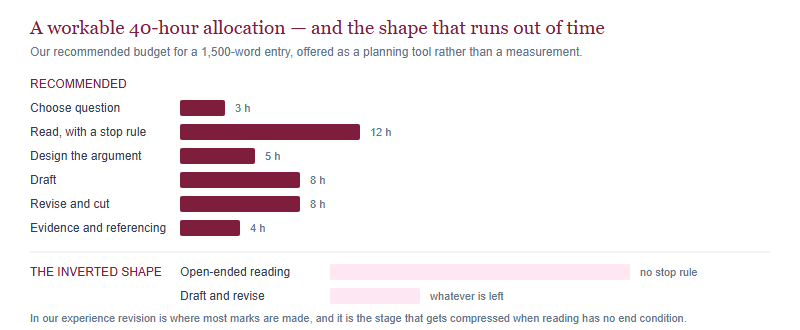
Two questions to answer in writing at the end of the post-mortem. First: what was the earliest point at which the outcome became likely? Almost always it is a date in July, not the last week. Second: what single habit, if it had existed, would have changed that date? One habit, not five. A student who fixes question choice by a fixed date next year has done more for their 2027 entry than one who resolves to “start earlier”.
Finally, on how to talk about this. An unsubmitted essay is not a credential and should never appear on an application as though it were an entry. But the reading behind it is real supercurricular substance, and it is entirely legitimate to say you spent the summer working on a question in labour economics or monetary policy and to be able to discuss it. If you want to understand what a competition essay does and does not signal to admissions readers before you commit a second summer to one, that is a question worth answering honestly first; our guide to structuring the 1,500-word essay is also the fastest way to see what the format actually demands.
Frequently asked questions
Can I still submit a day or two late?
No. Late submissions are not accepted and there is no registration record to amend. Any exception is the organisers' to grant, via lsesuesec.org.
Does missing it hurt my university application?
Nobody knows you intended to enter, because entry never involved registration. There is no record of a missed entry anywhere.
Can I enter the same essay in a different competition now?
Sometimes, but never assume. Each competition sets its own rules on prior and simultaneous submission. Check its official site first.
Is it worth finishing a draft I can no longer submit?
Usually yes, if it can feed an EPQ, extended essay or internal assessment. Check your school's rules on reusing your own work first.
Published by the LSESU Essay Competition editorial desk, operated by Hanlin Education for China-based international-school students. Official rules are set by the competition and change yearly — confirm current details on lsesuesec.org. Errors are corrected within 7 working days.