Unlearning the Exam Template: Why IB and A-Level Habits Cost Marks in an LSESU Essay
Two years of economics teaching has trained you to define your terms, show both sides and end with “it depends.” That is exactly what an examiner pays for. It is not what the LSESU criteria pay for: the largest single band of marks rewards an argument that, in the competition's own published wording, goes beyond textbook answers. Same subject, opposite instincts.
Two mark schemes that reward opposite instincts
Nobody writes an exam-shaped competition essay on purpose. It happens because school writing is assessed by level descriptors that reward coverage, balance and correct terminology, and after two years those moves stop feeling like choices. They feel like what an economics essay is. Then the same student writes 1,500 words for a competition scored on seven criteria weighted heavily towards a position that a specialist reader has not already heard, and the habits quietly work against them.
The table below is the whole article in one place. Read the right-hand column as the replacement move, not as a rule to memorise.
| Exam habit | Why it earns marks in a school answer | What it costs against the published criteria | The replacement move |
|---|---|---|---|
| Define every key term up front | Demonstrates knowledge before the analysis begins | Spends words that argument and originality never repay; definitions are not argument | Define only the terms your argument turns on, in the sentence where they do work |
| Draw and describe the diagram | Shows the model and earns analysis marks | Application of theory rewards a model that does work, not one that is displayed | Use the model to generate a prediction, then spend the words testing whether it holds |
| On the one hand, on the other | Signals balance to a level-descriptor mark scheme | Critical analysis rewards engaging the strongest opposing view, not listing two of them | Take one objection, state it at full strength, and answer that version |
| The hedged conclusion | Safe: it is difficult to be wrong when you have not committed | A non-committal ending reads as a summary of the consensus, which is where the biggest criterion loses marks | Commit, then say precisely what evidence would change your mind |
| List four determinants | Coverage protects you when the examiner is looking for any of several points | Breadth crowds out the single mechanism that a specialist reader wants followed through | One mechanism, traced from assumption to implication without a gap |
| The familiar textbook case | Recognisable, safe, and quick to deploy | Evidence and example rewards checkable specifics with a source, date and population | One named study or dataset, with its limitation stated by you first |
| Answer the command term | Keeps the answer on task | Nothing — this habit transfers intact | Keep it. Relevance and structure are 15 marks of the competition rubric too |
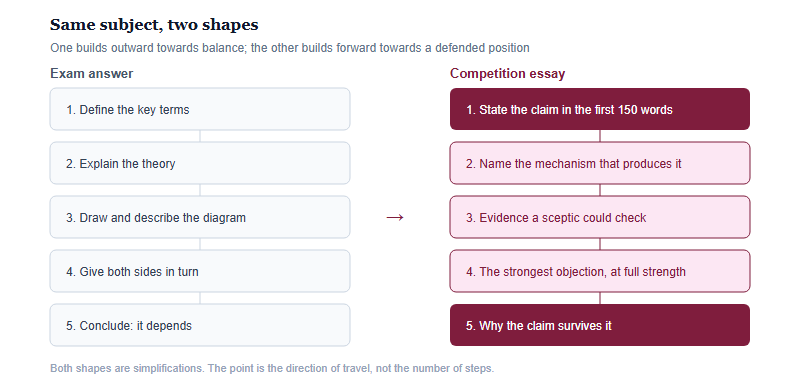
The two shapes, side by side
It helps to see the structural difference rather than argue about it. The exam answer builds outward from knowledge towards a balanced judgement. The competition essay builds forward from a claim towards a defended one.
The definitions problem, in words you can count
The word limit is a maximum of 1,500 words, excluding references. That number is small enough that habits become arithmetic. Take a competent exam-shaped opening: four key terms defined at roughly forty words each is 160 words. A described diagram is comfortably 120. A two-sided evaluation paragraph that arrives nowhere in particular runs to 200. That is 480 words — almost a third of the essay — spent before the specialist reader has met a single idea that is yours.
Those figures are illustrative, but run the version for your own draft and the result is rarely comfortable. The productive question is not “is this paragraph good?” It is “which criterion is this paragraph buying, and at what price per word?” A definitions paragraph buys almost nothing in a competition rubric, because knowledge of terminology is assumed rather than rewarded. The same 160 words spent tracing one mechanism from assumption to implication is buying from the two largest criteria at once.
There is a useful exception. Define a term when the definition is doing argumentative work — when your whole case turns on reading “inequality” as dispersion in hourly pay rather than in household wealth, say, or on separating monitoring of hours from monitoring of output. That is not a definition paragraph. That is the argument, and it belongs in the sentence where it bites. Our walkthrough of how the 1,500 words are built shows where those decisions sit in a finished piece.

Why “it depends” is exam-safe and competition-expensive
In a school answer, the hedged conclusion is rational behaviour. Level descriptors reward showing that you understand the conditions under which a result holds, and a firm position can be marked down if the counter-case is not acknowledged. So students learn to end on the elasticity, the time frame or the assumption that everything depends on government policy. It is difficult to be wrong that way, and that is precisely the appeal.
Now read the criteria. The largest band rewards an argument described in the published wording as innovative and going beyond textbook answers, and a separate band of marks rewards engagement with opposing views and trade-offs. Notice that these are two different jobs. “It depends” attempts to satisfy the second one while quietly declining the first. It reads as a student who has understood the debate rather than entered it.
The replacement is not recklessness. It is conditional commitment: state your position, then state the conditions under which it fails and why you judge those conditions not to hold in the case you have chosen. “Monitoring output rather than hours dominates, unless the output is jointly produced and cannot be attributed to individuals — which is why this argument is about sales teams and not about research groups.” That sentence takes a side, shows the boundary, and demonstrates the discipline the hedged version was reaching for. It is also considerably harder to write, which is the point of a 25-mark criterion.
What your exam training genuinely gives you
None of this means school economics is bad training. Students who arrive from a rigorous IB or A-Level course have three advantages over students who do not, and they are exactly the advantages the smaller criteria reward: they answer the question that was asked, they write in paragraphs that go somewhere, and they use terminology precisely rather than decoratively. That is relevance and structure, and it is fifteen marks of the competition rubric before any economics has happened.
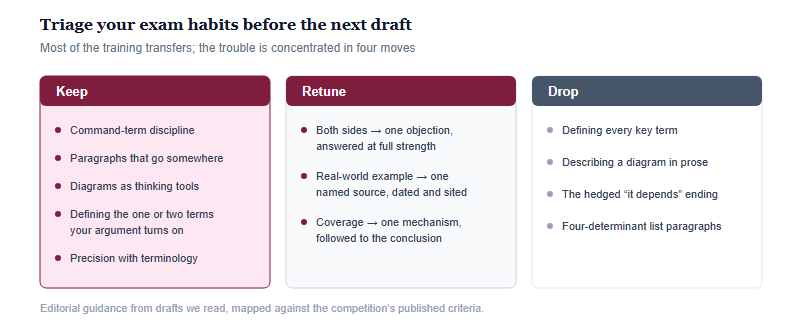
The diagram question deserves one clarification, because students over-correct. Keep drawing diagrams — on paper, for yourself. A model you have drawn is a model you can interrogate, and interrogating it is how you find the mechanism worth writing about. Whether the diagram belongs in the submitted document is a separate decision about whether it earns its space, and that is a judgement about word economy rather than about economics.
How to run the retune on your own draft
Do it as an editing pass, not as a rewrite. Open the draft and mark, in the margin, which criterion each paragraph is buying from. Any paragraph you cannot assign is a paragraph written by habit rather than by decision — that is not automatically a reason to delete it, but it is always a reason to ask. Then check three specific things: does the first 150 words contain a claim rather than a preview; does every “studies show” have a name attached; and does the conclusion say something the introduction did not already promise.
Students who have never entered before sometimes read all this as a warning that the competition is a different subject from the one they study. It is not. It is the same economics, assessed by readers who want to see you think rather than see you demonstrate. If you are working out whether the competition is worth your term at all, our overview of what it is and who runs it sets out the shape of the cycle.
Frequently asked questions
Is my IB or A-Level training a disadvantage here?
No. It gives you structure, precision and command-term discipline. The problem is only the habits built for a different mark scheme.
Should I still use diagrams?
Use them to think. Whether one belongs in the submitted essay is a separate judgement about whether it earns its share of 1,500 words.
Am I allowed to write a one-sided essay?
You take a position, then answer the strongest objection to it. That is not one-sided, and the criteria reward exactly that move.
How many terms should I define?
Only those your argument turns on, defined where they do work. In 1,500 words a definitions paragraph is expensive shelf space.
Published by the LSESU Essay Competition editorial desk, operated by Hanlin Education for China-based international-school students. Official rules are set by the competition and change yearly — confirm current details on lsesuesec.org. Errors are corrected within 7 working days.