From 1,500 Words to 4,000: Turning Your LSESU Essay into an IB Extended Essay or EPQ
You can build an Extended Essay or an EPQ on the reading you did for the LSESU Essay Competition — but not on its text. The two documents reward opposite things: a competition essay argues a position in 1,500 words, while a research project asks a narrower question and shows its method over 4,000. September is when that conversion has to happen, because supervisors want a research question this term.
The two documents are not the same shape
Students who try to stretch a competition essay into a research project usually produce a padded essay: the same argument, the same evidence, with three extra examples and a longer conclusion. It reads thin because the extra length was spent on more of what was already there, rather than on the parts a research project is actually assessed on. The differences are structural.
| LSESU Essay Competition | IB Extended Essay | EPQ | |
|---|---|---|---|
| Length | 1,500 words maximum, excluding references | 4,000 words maximum | A dissertation-style report, commonly in the region of 5,000 words — confirm with your centre |
| Where the question comes from | Chosen from a public set written by LSE economists | Formulated by you, approved by a supervisor | Formulated by you, agreed with a supervisor |
| What is being judged | Seven published criteria over 100 marks, weighted towards argument and originality | Criteria including the framing of the question, engagement with sources, analysis, discussion and reflection | Project management and process, alongside the report itself |
| Method | Implicit — there is no room for a method section | Explicit, and assessed | Explicit, plus a production log recording decisions |
| Supervision | Your own work; feedback rules are set by the competition | Formal supervision with recorded meetings | Formal supervision plus a presentation |
| What counts as success | An argument a specialist reader has not already heard | A question answered properly, with limitations acknowledged | A defensible project delivered and reflected on |
Read that table as one sentence: the competition rewards a conclusion, the research project rewards a process. That is why the conversion cannot be additive.
Rebuild, do not recycle: the integrity line
This is the part to get right before anything else. Reusing your own previously submitted work in a new assessment is not a grey area you can quietly resolve for yourself. Examination boards set their own rules on reusing material you have already submitted elsewhere, and the fact that you wrote it does not make it invisible to text-matching software. Before you reuse a single paragraph, tell your supervisor what exists and where it went.
The workable rule is simple: reuse the research, not the writing. Your bibliography, your notes on each paper, the dataset you found, the definitions you had to nail down, the objection that nearly broke your argument — all of that is yours to carry forward, and it is genuinely the expensive part. The 1,500 words themselves are the cheapest thing you own. They took a fortnight; the reading took months.
In practice that means opening a blank document, not a copy. If a sentence from the competition essay is so good that you want it verbatim, that is a signal you should quote and attribute it as your own prior work, with your supervisor's agreement, rather than slide it in silently. Schools differ on what they permit here, which is exactly why the conversation belongs at the start of September rather than at the point of submission.
Three conversion routes from an argument to a research question
A competition essay contains, somewhere in it, the joint you were least confident about — the step where you wrote “plausibly” or “arguably” because you did not have the evidence to write “because.” That joint is your research question. There are three standard ways to open it up.
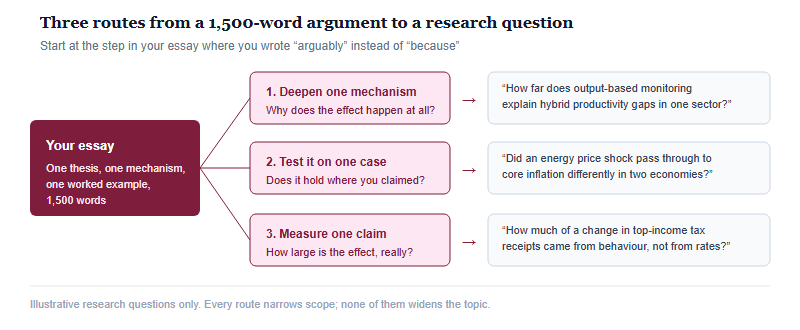
Route one suits questions where you asserted a channel without demonstrating it — questions about labour markets and incentive design are full of these, because incentive design is easy to describe and hard to evidence. Route two suits policy questions, where the argument was developed in one institutional setting and you can ask honestly whether it survives elsewhere. Route three is the most demanding and the most rewarded, because it forces you into a dataset and therefore into a method.
Whichever route you take, apply the narrowing test: a good research question names a population, a period and an outcome. “Does AI increase inequality?” fails all three. “How did occupational exposure to automation relate to wage dispersion within one national labour market over one decade?” passes, and can actually be answered in 4,000 words.

What the extra 2,500 words have to buy
Here is the trap in one image. The competition essay spends almost everything on argument, because the rules leave it no choice. A research project has to spend a large share of its length on the two things the competition essay could not afford: how you know what you claim, and what would have to be true for you to be wrong.
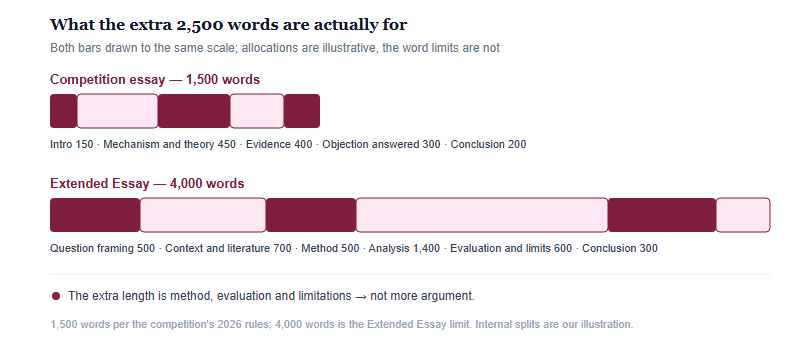
This is also why students who worked hard on the competition essay often find the research project easier than their classmates do. You have already practised the single hardest habit — answering the strongest objection rather than a convenient one — and in an Extended Essay that habit reappears as the evaluation and limitations sections, which is where a lot of marks quietly live. If you want a refresher on how tightly a 1,500-word argument is engineered, our walkthrough of how the essay is built paragraph by paragraph shows the constraint you have just escaped.
A four-week September build
Most schools want a research question, a supervisor allocation and a first meeting during the autumn term. Four weeks is enough if you use what you already have.
- Week 1 — harvest. Re-read your competition essay once, cold. Mark every “arguably”, “plausibly”, “it seems likely” and every claim with no citation. Then rebuild your bibliography as a proper annotated list: source, what it actually shows, and its main limitation. This is the asset. Do not open the essay text again after this week.
- Week 2 — narrow. Pick one route from the diagram above and draft three candidate questions, each naming a population, a period and an outcome. Check that data or literature exists for each one before you fall in love with it. A beautiful question with no accessible evidence is the most common way an Extended Essay stalls in February.
- Week 3 — the supervisor conversation. Bring all three questions, the annotated bibliography, and a plain statement of what you already submitted to the competition and when. Ask directly what your school's rule is on building on prior work. Get the answer before you write, not after.
- Week 4 — the method paragraph. Write 300 words on how you will answer the question: what evidence, from where, compared against what, and what result would count as answering it in the negative. If you cannot write that paragraph, the question is not ready, and no amount of reading will make it ready.
What the pair does inside an application
An economics competition entry and a research project on a related question are worth more together than separately, and it is worth understanding exactly why. Admissions readers do not assess an entry in isolation; they read it against your transcript, your subject choices and what you write about yourself, and a file becomes believable when those elements corroborate one another. A student whose competition essay, Extended Essay and subject grades all point at the same intellectual interest has a file that cross-checks. A student with one impressive line and nothing around it does not.
Two cautions. First, none of this guarantees anything, and any adviser who tells you a competition plus a research project produces an outcome is selling you something. Second, the corroboration only works if the work is genuinely yours and you can still discuss it months later — which is another argument for rebuilding rather than recycling. The version you rebuilt from your own notes is the version you can defend in a conversation. For the wider context of what the competition is and who runs it, see our overview page.
Frequently asked questions
Can I submit the same essay as my Extended Essay?
No. The formats differ, and boards set their own rules on declaring work you have already submitted elsewhere. Rebuild from the research and tell your supervisor.
Is 1,500 words of research enough to build a 4,000-word project?
It is enough for the argument, not the method. Expect to add a literature section, an explicit method and a limitations chapter.
Which kind of question converts best?
Any question you can narrow to one population, one period and one outcome. Broad normative questions resist a testable research question.
When should this conversion happen?
September. Supervisors want a research question in the autumn term, and your reading is still loaded in working memory right now.
Published by the LSESU Essay Competition editorial desk, operated by Hanlin Education for China-based international-school students. Official rules are set by the competition and change yearly — confirm current details on lsesuesec.org. Extended Essay and EPQ requirements are set by the IB and by individual awarding bodies; confirm those with your school. Errors are corrected within 7 working days.