LSESU Essay Past Prompts as Practice: A Training Method
As of October 2026, the 2026 LSESU Economics Society Essay Competition deadline has passed. The official deadline was 1 September 2026 at 23:59 GMT+1, with no extension. For ambitious students, this creates a practical problem: the next official prompt set is not needed for useful preparation, but doing nothing until new prompts appear wastes months of skill-building time. At the same time, recycling a 2026 answer for a future entry would be a mistake, because the official rules state that one essay answers one of the five questions and that submissions cannot be revised or replaced after submitting.
The better path is to treat the public 2026 questions as a training gym. The goal is not to produce a submission-ready answer for a past contest. It is to build the reasoning, evidence, and time-management muscles that any future LSESU-style economics essay will demand. This article sets out a deliberate method for LSESU Essay Past Prompts as Practice: a 90-minute drill, a structured prompt log, weekly skill rotations, and a clear integrity boundary between practising an old prompt and reusing an old answer.
What Practice Means After the Deadline
Once a deadline has closed, the objective shifts from competition entry to skill acquisition. The official baseline is simple: the competition uses five public questions, requires no registration, is free to enter, asks for one 1,500-word English essay, and accepts direct submission to the official portal. The rules also confirm that one essay answers one of the five questions. Those facts matter for practice because they define the constraints you are training under: a tight word limit, a single-question focus, and no second chance to revise after submitting.
When the next official prompts are not yet available, you cannot practise the exact 2027 question. You can, however, practise the cognitive tasks that any serious economics prompt will require. You can practise selecting evidence, defining a mechanism, comparing a policy with a feasible alternative, separating short-run effects from long-run adjustments, and explaining who gains and who loses. These skills do not expire when a prompt set ages. They are the durable part of preparation.
Practice in this context means repeated, timed work on high-value analytical sections. Instead of writing a full essay every week, you isolate one difficult part of the argument and improve it. That is more efficient than waiting for inspiration or spending hours polishing an introduction that will not transfer to the next prompt.
How to Use Public Prompts Without Pretending They Are the Next Contest
Public 2026 prompts are useful because they are real LSESU-style questions, not because they predict the future. Do not treat any old prompt as a forecast. Treat it as a static training object. You are not trying to guess the 2027 question. You are trying to improve your response to a certain type of economic demand.
This distinction has practical consequences. If you spend three weeks trying to reverse-engineer which topics the next competition will favour, you are doing speculation, not preparation. If you spend three weeks practising how to build a causal mechanism under a word limit, you are doing preparation that will help regardless of the topic.
A useful rule is to ask of every public prompt: what is the dominant analytical task here? Is it a policy trade-off? A distributional question? A macroeconomic adjustment? A technology-and-labour question? You do not need the official 2026 set to be officially sorted into those categories for this exercise to work. You are classifying the prompt for your own training purposes. The classification is a teaching tool, not an official taxonomy.
Classify the Analytical Task, Not the Topic Label
Many students sort prompts by topic: tax, trade, inflation, artificial intelligence, wages. Topic labels are useful for reading, but they are weak for training. Two prompts about tax can demand completely different skills. One may require distributional analysis; another may require a trade-off between efficiency and administrative cost. The analytical task, not the topic noun, should determine your drill.
| Analytical Task to Practise | What You Are Training | Useful Concepts |
|---|---|---|
| Policy trade-off | Comparing two options under the same assumptions | Opportunity cost, efficiency versus equity, feasibility |
| Distributional effect | Explaining who gains, who loses, and why | Incidence, inequality, welfare analysis |
| Macroeconomic adjustment | Separating immediate effects from long-run responses | Inflation, unemployment, fiscal and monetary policy |
| Technology and labour | Building a causal chain from change to outcome | Automation, productivity, skill-biased change |
A teaching illustration: if you adapt a public prompt’s theme into a drill about a minimum-wage change, classify it as a distributional-effect task if the central question is who gains and who loses. If the central question is whether the policy is better than a tax credit, classify it as a policy trade-off. The same topic can support different drills. That is a feature, not a problem.
The 90-Minute Training Loop
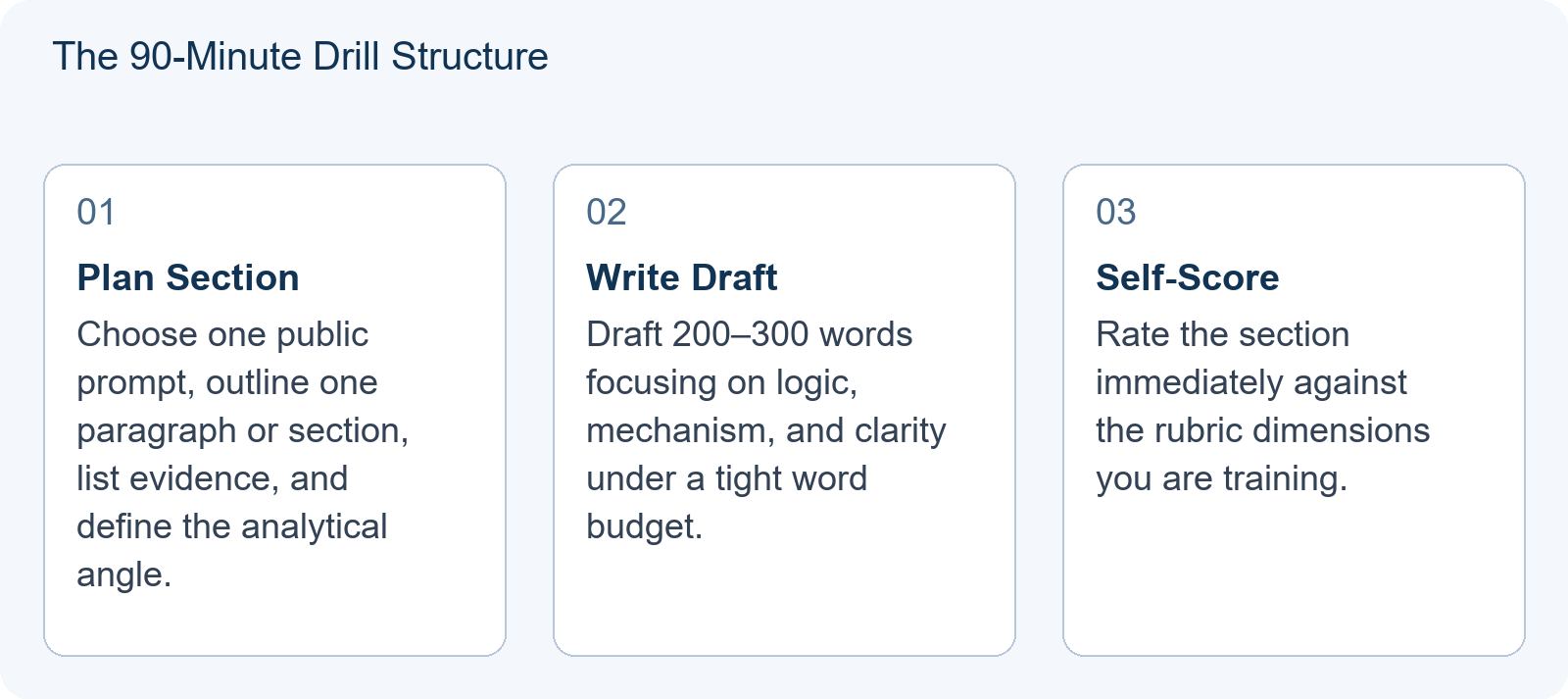
A common mistake is spending several hours on one draft without feedback. A better method is a strict 90-minute loop with three phases: planning, writing, and self-scoring. The loop is short enough to repeat weekly and long enough to force real analytical decisions.
Phase 1: Planning, 20 minutes. Select one public prompt. Do not write the full essay. Instead, outline one critical section: the counterargument, the mechanism paragraph, or the distributional analysis. List the evidence you would use and identify the core economic model or relationship. This forces rapid decisions about relevance and scope.
Phase 2: Writing, 60 minutes. Write the selected section within a proportional word budget. A key section in a 1,500-word essay will often be 200–300 words. Focus on clarity and logical flow. Avoid introductory padding. Dive directly into the analysis. This constraint mimics the tight word budget of the competition.
Phase 3: Self-scoring, 10 minutes. Review your section against the rubric dimensions you are training. The official framework is a 100-point rubric, with originality as the highest-weighted component at 25 points. Even when you are not writing a full essay, ask whether your section shows an original angle, whether it answers the question asked, and whether the causal link is explicit. Score the section immediately. Immediate feedback exposes weaknesses faster than waiting for external review.

Keep a Prompt Log That Exposes Weaknesses
Memory is unreliable across weeks. Keep a digital or physical prompt log for every drill. The log becomes a portfolio of analytical growth and a diagnostic record.
- Exact prompt: Copy the public prompt you are using, or write a short paraphrase if you are adapting it for a teaching drill.
- Your angle: State the thesis or perspective in one sentence.
- Evidence list: Record the statistics, studies, or theories you used, and why each was relevant.
- Counterargument: Write the strongest opposing view you addressed.
- Mechanism test: Write one sentence explaining the elasticity, incentive, or transmission mechanism you relied on.
Over several entries, patterns appear. You may notice that you consistently define opportunity cost loosely or that your distributional analysis stops at naming winners and losers without explaining incidence. Those patterns tell you what to drill next. A prompt log turns random writing into targeted practice.
The Integrity Boundary: Practise Reasoning, Not Recycling
The line between practice and reuse must be clear. The official rules confirm that submissions cannot be revised or replaced after submitting. That means a recycled answer is not a safe strategy. More importantly, reusing a past answer weakens your preparation because you are not practising the act of responding to a new question.
Do not submit a 2026 answer as a future entry. Even if a prompt appears similar, the context and the expected reasoning may differ. Instead, use the old prompt to generate a new argument. If you find yourself repeating the same structure from a previous year, stop and ask: what would a different assumption, a different time horizon, or a different distributional lens reveal?
Third-party model answers should also be handled carefully. They can be teaching illustrations, but they are not official templates. The official rules and dates should be checked at lsesuesec.org. A model answer may show one way to structure an argument, but it does not replace your own reasoning.
Weekly Skill Rotations
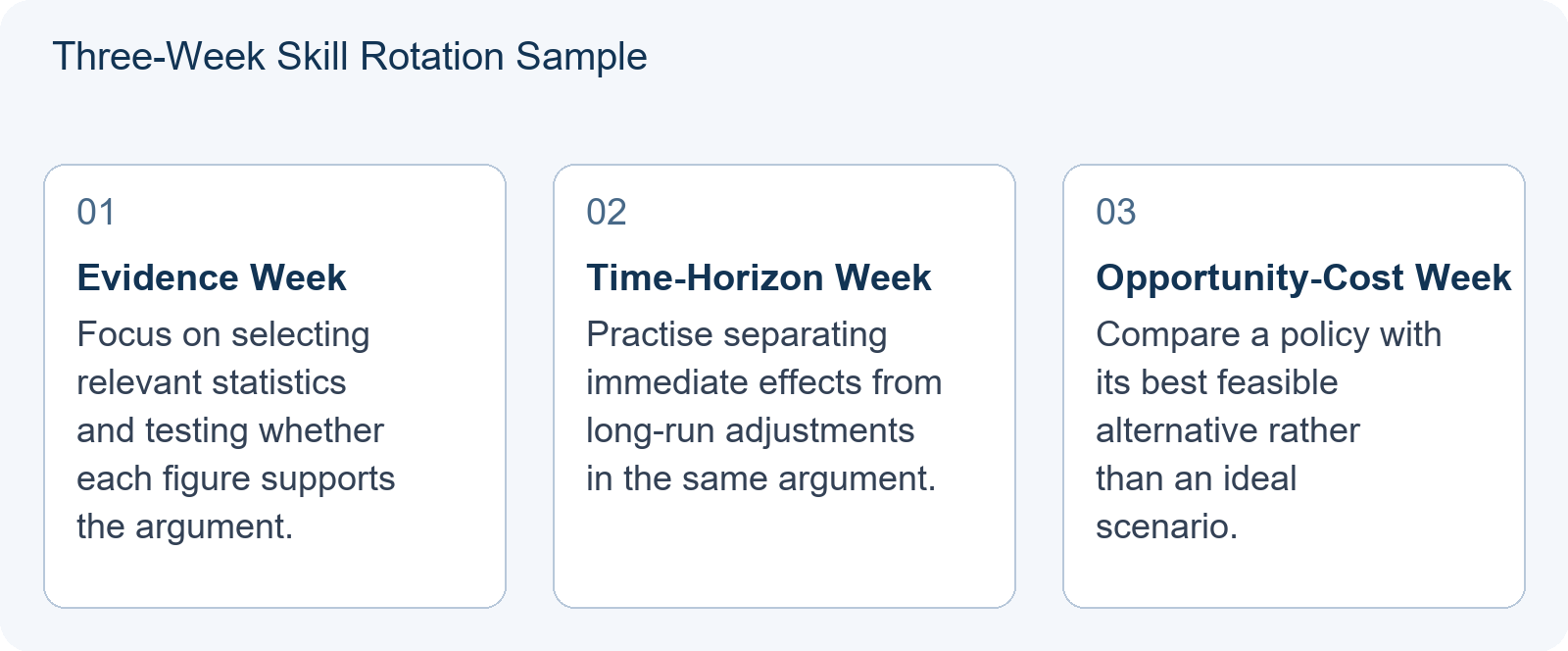
Rather than writing full essays repeatedly, rotate one core skill each week. This prevents burnout and gives each rubric demand proper attention.
- Evidence selection: Practise choosing the most relevant statistic over the most famous one. See LSESU Essay Evidence Selection: Use a Statistic to Test an Argument for a method of testing whether a number actually supports the claim.
- Time horizon: Distinguish short-term shocks from long-run adjustments. See LSESU Essay Time Horizons: Separate an Immediate Effect From a Long-Run Adjustment for guidance on separating immediate effects from longer-run responses.
- Opportunity cost: Compare a policy with its best feasible alternative, not with an ideal scenario. See LSESU Essay Opportunity Cost: Compare a Policy With Its Best Feasible Alternative for a framework on realistic comparison.
- Distribution: Map winners and losers explicitly. Who bears the burden? Who captures the surplus? Which group is easy to overlook?
- Causal inference: Move beyond correlation. Explain the mechanism linking cause to effect, and identify one rival explanation.
One week per skill is enough to build depth without turning preparation into a full-time job. If a week goes badly, repeat the skill rather than moving on. The goal is not coverage. The goal is reliable analytical habits.
When to Stop Practising and Wait for the Official Prompts
There is a diminishing return on practising with old prompts. After several 90-minute cycles, you should notice that planning becomes faster, mechanism sentences become clearer, and self-scoring becomes more honest. At that point, stop forcing practice on 2026 topics. Continued repetition can create anchoring bias, where you unconsciously expect a new prompt to fit an old template.
Shift instead to general reading of current economic news, policy debates, and accessible academic papers. Keep your prompt log nearby. Occasionally repeat a short drill using a new article as evidence, not a new contest prompt. When the next official prompt set is published, check the official website for the authoritative rules and dates, then apply your honed skills to fresh material.
This site is an independent information resource operated by Hanlin International Education. It is not affiliated with, endorsed by, or authorized by the LSESU Economics Society, the LSE Students’ Union, or the London School of Economics. For official rules, dates, and announcements, always refer to the official competition website at lsesuesec.org.
Frequently Asked Questions
Can I submit my 2026 practice essay for the 2027 competition?
Not as a recycled answer. The official rules tie an entry to one of the five questions and do not allow a submitted essay to be revised or replaced after submission. Use the public 2026 prompt only as practice and build a new answer when the next official prompts are available.
Where can I find the official prompts when they are released?
Check the official competition website at lsesuesec.org. This article is an independent guide and does not publish official prompt sets or official deadlines.
Is this site the official competition organizer?
No. This site is an independent information resource operated by Hanlin International Education. It is not affiliated with, endorsed by, or authorized by the LSESU Economics Society, the LSE Students’ Union, or the London School of Economics.