Using Evidence and Data in Your LSESU Essay (and Passing the AI Screen) 2026
A strong LSESU essay does not just assert an economic claim — it backs the claim with evidence and then analyses that evidence. But the competition also screens every submission for AI-generated content and plagiarism, with immediate disqualification for breaches. This guide shows how to source and cite real data inside the 1,500-word limit, how to turn a statistic into argument rather than decoration, and how to keep your writing unmistakably your own.
Evidence is scored on use, not on volume
Per the official rules on lsesuesec.org, you write a single essay of up to 1,500 words (excluding references) answering one of five questions, with Harvard referencing recommended. Because references sit outside the word count, citing carefully is cheap. What is expensive is body words — so every data point you bring in must do analytical work, not just sit on the page.
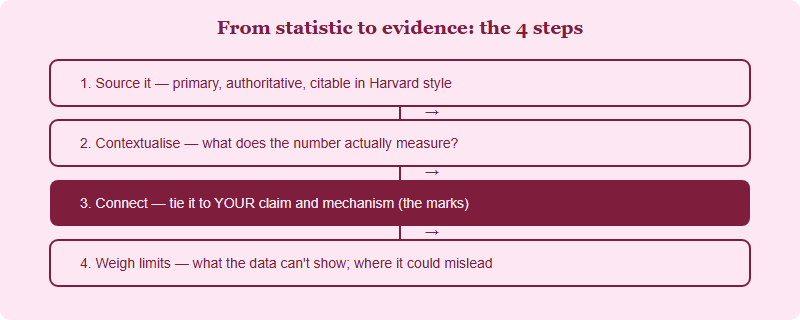
The distinction that separates placing essays from the rest: a weak essay states a number; a strong essay uses it. “Inflation rose to X%” is decoration. “Inflation rose to X%, which matters here because it shifts the real return on the policy I am analysing, so the mechanism I described above predicts…” is analysis. Our breakdown of the 100-point rubric shows that the marks live in the second sentence, not the first.
| Evidence move | Decoration (low marks) | Analysis (high marks) |
|---|---|---|
| Citing a statistic | Drops the number, moves on | Explains what the number implies for the mechanism |
| Using an example | “For example, country X did this” | Shows how X confirms or complicates the claim |
| Quoting a study | Name-drops a famous economist | Engages with the finding and its limits |
| Presenting a trend | “This has increased over time” | Links the trend to the causal story being argued |
Where to find credible economic data
You do not need exotic sources. You need authoritative, verifiable ones that a judge can trust and you can cite cleanly in Harvard style. Prioritise primary statistical bodies over secondary summaries.
- National and international statistics: bodies such as the OECD, the World Bank, the IMF, and national statistics offices publish the raw indicators most economics prompts need.
- Central banks: for monetary, inflation, and interest-rate arguments, central-bank data and reports are primary and well-respected.
- Peer-reviewed and working papers: for mechanisms and causal claims, an academic study is stronger than a news article reporting it. Cite the study, not the headline.
- Reputable data journalism: useful for orientation, but trace the underlying source and cite that where you can.
A first-party tip from reviewing drafts: two or three well-chosen, well-analysed sources beat a wall of citations. Under 1,500 words you simply cannot develop ten data points — and an essay that name-drops ten sources without analysing any reads as padding to an experienced judge.

Citing cleanly with Harvard referencing
Harvard referencing is recommended, and because references are excluded from the word count, there is no excuse for sloppy citation. The pattern is simple: an in-text marker at the point of use, and a full entry in a reference list at the end.
| Element | Where | What to include (verify exact style on official guidance) |
|---|---|---|
| In-text citation | At the claim it supports | Author/organisation and year, e.g. (Author, Year) |
| Reference list | End, after the essay | Full source details; outside the 1,500-word count |
| Data point | In the argument | Cite the dataset/publisher and year you drew it from |
| Direct idea from a study | In the argument | Attribute it; never present a borrowed idea as your own |
Two habits keep you safe. First, cite as you write, not afterwards — reconstructing sources at the end is when accidental plagiarism creeps in. Second, every number, every paraphrased finding, and every distinctive idea that is not yours gets a citation. Attribution is not just integrity; it is part of how a judge sees that you have read real economics.
Passing the AI and plagiarism screen
The rules are blunt: plagiarism and AI-generated content are strictly forbidden, all essays are screened, and breaches are immediately disqualified. The goal here is not to “trick a detector” — it is to write genuinely human analysis, which is also what scores. The two aims point the same way.
What human, original economics writing looks like:
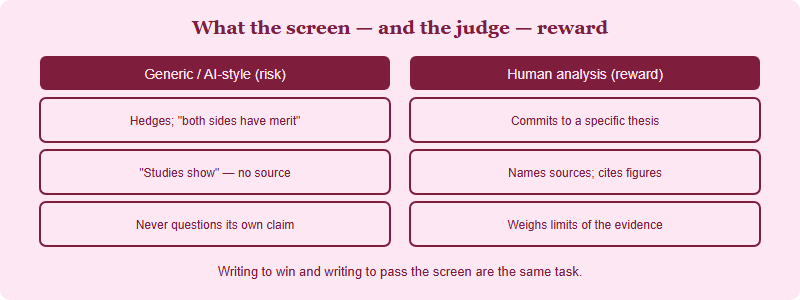
- A specific thesis with a point of view — AI-style prose tends to hedge, balance everything, and conclude that “both sides have merit.” A real argument commits.
- Engagement with limits — you note what your evidence cannot show. Generic generated text rarely interrogates its own claims.
- Your own connective reasoning — the sentences that link a statistic to your mechanism are where your voice lives. Write those yourself, always.
- Concrete, checkable detail — real sources, real figures you can defend, not vague gestures at “studies show.”
A practical, honest line on tools: using a spell-checker or asking a teacher to mark up your draft is normal editing. Submitting text a model wrote, or paraphrasing a model's argument as your own, is the breach the screen exists to catch — and it is also a thin essay, because the analysis is not yours to defend. If you cannot explain every sentence of your essay in your own words, that sentence is a liability. For the wider integrity rules and common pitfalls, see our overview of what the LSESU Essay Competition is.
An evidence checklist before you submit
Run this pass once your argument is built. For the live questions and the full scoring picture, see the 2026 prompts and rubric.
- Every statistic is cited and analysed — none sits as decoration.
- Sources are primary and authoritative; you can defend each one.
- Citations use Harvard style (confirm exact format on official guidance) and sit outside the word count.
- You have noted at least one limit of your evidence.
- Every sentence is one you can explain in your own words — no model-written or borrowed text.
- Submit directly at lsesueconsoc.org/competitions/; no registration; deadline 1 September 2026, 23:59 (GMT+1).
FAQ
Do citations count toward the 1,500-word limit?
No. Per lsesuesec.org the limit excludes references, so a proper reference list does not cost body words. Confirm edge cases on the official site.
How many sources should an LSESU essay use?
There is no fixed number, but two or three well-analysed authoritative sources beat a long list of name-drops you never engage with.
Is using AI to help write the essay allowed?
No. AI-generated content is strictly forbidden and screened; breaches are disqualified. Write and reason in your own words.
What referencing style is recommended?
Harvard referencing is recommended. The exact format can vary by guide, so confirm the recommended style on official competition guidance.
Published by the editorial desk of this site, operated independently by Hanlin International Education (翰林国际教育) for China-based international-school students. This site is not the official competition website and is not affiliated with the LSESU Economics Society or the London School of Economics. Official rules are set by the competition and change yearly, so always confirm current details on the official site lsesuesec.org. Confirmed errors are corrected within 7 working days.