Referencing and Academic Integrity for the LSESU Essay Competition: A 2026 Harvard-Style Citation Guide
Referencing is not an afterthought in the LSESU Economics Society Essay Competition — it is one of the published criteria your essay is marked against, so clean Harvard citations in the final weeks convert directly into marks. This guide covers in-text citations, the reference list, how to weave sources into your argument, and the competition’s rules on originality and AI use.
Why referencing is worth real marks
Markers use referencing as a quick, reliable signal of scholarship. Accurate, consistent citations tell them you have read widely, engaged with real economics, and can separate your own analysis from borrowed ideas. Sloppy referencing signals the opposite — and because referencing sits in the mark scheme alongside originality, relevance, structure, clarity and depth of argument, careless citation quietly costs you a scored criterion you could have banked with an hour of tidying. You can see where referencing fits in the wider mark scheme in our breakdown of the 2026 prompts and rubric.
The official guidance recommends Harvard referencing, an author–date system used across economics. The principle is simple: in the body of your essay you flag a source briefly with the author and year; at the end, a full reference list gives readers everything they need to find it. If the competition specifies a particular style or format in a given year, follow that — always confirm current requirements on the official site.
Harvard in-text citations, the essentials
In-text citations are short and go wherever you use someone else’s idea, data or words. The basic unit is the author’s surname and the year of publication in brackets. Add a page number when you quote directly or cite a specific figure, so a reader can locate it exactly. The table below shows the common patterns as generic templates — replace the placeholders with your real sources.
| Situation | In-text pattern |
|---|---|
| Paraphrasing an idea | (Surname, Year) |
| Quoting or citing a specific figure | (Surname, Year, p. 12) |
| Author named in your sentence | Surname (Year) argues that… |
| Two authors | (Surname and Surname, Year) |
| Three or more authors | (Surname et al., Year) |
| Two sources at once | (Surname, Year; Surname, Year) |
One habit avoids most errors: cite as you write, never after. Trying to reconstruct citations from memory the night before the deadline is how figures get mismatched to sources and how honest students drift into accidental plagiarism.
The reference list, entry by entry
Your reference list appears at the end, ordered alphabetically by author surname, and includes every source you cited — no more, no less. Each entry answers four questions: who wrote it, when, what it is, and where to find it. Keep the punctuation and order identical across entries; consistency is what markers actually notice.
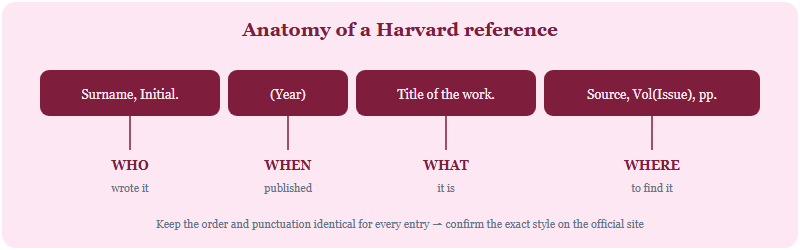
Different source types slot into the same logic with small variations. Use the generic templates below and adapt them to whatever style the competition confirms for the current year.
| Source type | Generic template |
|---|---|
| Book | Surname, Initial. (Year) Title. Place: Publisher. |
| Journal article | Surname, Initial. (Year) 'Article title', Journal, Vol(Issue), pp. x–y. |
| Working paper | Surname, Initial. (Year) Title. Working Paper No. Institution. |
| Official report / dataset | Organisation. (Year) Title. Place: Organisation. |
| Web page | Author/Organisation. (Year) Title. Available at: URL (Accessed: date). |

Integrate sources like an economist
Strong essays use sources to build the writer’s argument, not to replace it. As a rule, paraphrase far more than you quote: putting an idea into your own words shows understanding, whereas a wall of quotations shows only that you can copy. Reserve direct quotation for wording that is genuinely precise or memorable, and keep it short. Whenever you introduce a source, signal what you are doing with it — “Evidence from… suggests,” “In contrast, … finds” — so the marker sees you weighing sources, not stacking them.
Every empirical claim should be traceable to something a reader could check, and every borrowed idea should carry a citation even when you have reworded it heavily. The test is ownership: the analysis, the judgement and the through-line must be yours; the facts and prior arguments you lean on must be attributed. If you want a refresher on turning sources into argument, our guide on how to write the essay shows how evidence supports a thesis rather than smothering it.
Academic integrity — plagiarism and AI
The LSESU essay must be your own individual work, and entries are screened for plagiarism and for AI-generated content; breaches can lead to disqualification. Treat that as a bright line and confirm the exact wording of the rules on the official site. The good news is that honest, well-referenced writing keeps you comfortably on the right side of it — the diagram below sorts everyday choices into sound practice and disqualification risk.
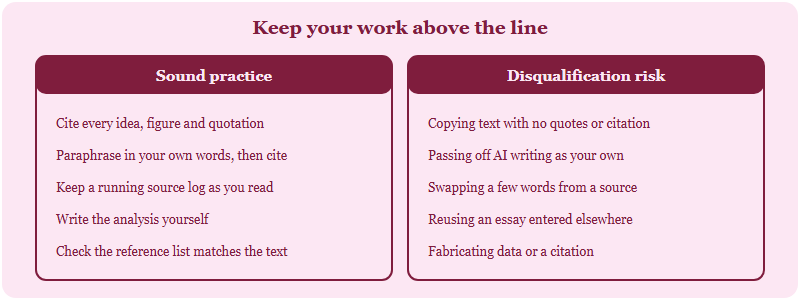
A word on AI, because it worries a lot of students. The goal is not to “beat a detector” — it is to submit genuinely human analysis, which is also what earns marks for originality and depth. Use AI, if at all, the way you would a dictionary or a search engine: to look things up, never to generate the argument or the prose you then claim as yours. Keep a source log while you research, cite everything you borrow, and let your own thinking carry the essay. That is both the safest and the highest-scoring way to write.
Your referencing checklist
Run this pass in the final week, ideally on a printed copy so nothing hides in the scroll.
| Check | What to confirm |
|---|---|
| Match | Every in-text citation has a full entry, and every entry is cited |
| Consistency | One style, one punctuation pattern, throughout |
| Order | Reference list alphabetical by author surname |
| Accuracy | Years, page numbers and titles verified against the source |
| Quotes | Direct quotations are short, marked and page-referenced |
| Originality | The argument and wording are demonstrably your own |
Frequently asked questions
Which referencing style should I use?
The official guidance recommends Harvard, an author–date system common in economics. If a given year specifies otherwise, follow that — always confirm current requirements on the official site.
Do references count towards the word limit?
This varies by competition and year, so do not assume. Check the official rules for whether the reference list and footnotes are included in the roughly 1,500-word limit.
Can I use AI tools while researching?
Entries are screened for AI-generated content and must be your own work. Never pass off AI writing as yours; use tools only to look things up, and confirm the rules on the official site.
What happens if I miss a citation by accident?
Uncited borrowing can read as plagiarism regardless of intent, so cite as you write and keep a source log. New here? Start with what the LSESU Essay Competition is.
Published by the editorial desk of this site, operated independently by Hanlin International Education (翰林国际教育) for China-based international-school students. This site is not the official competition website and is not affiliated with the LSESU Economics Society or the London School of Economics. Official rules are set by the competition and change yearly, so always confirm current details on the official site lsesuesec.org. Confirmed errors are corrected within 7 working days.