How to Read an Economics Paper in 30 Minutes: A Source-Triage Method for the LSESU Essay (2026)
Read an economics paper in this order: abstract, then the last three paragraphs of the introduction, then the headline table, then the robustness and limitations section. Skip the literature review and the model derivations on a first pass. Thirty minutes handled this way yields one precise, citable claim — which is all a 1,500-word essay can carry per source anyway.
In the final weeks, reading speed is the bottleneck — not writing speed
With roughly three weeks to the 1 September deadline, most entrants are not stuck for words. They are stuck because their argument needs one more piece of real evidence, they have found a promising 45-page working paper by an author whose name they recognise from the question, and they have no idea how to get through it before term restarts.
So one of two things happens. Either they cite the abstract and hope — which markers spot, because the essay uses the paper's headline sentence and nothing else — or they lose two evenings reading it front to back like a textbook chapter and emerge with notes they cannot use.
Both failures come from the same misunderstanding: academic papers are not written to be read linearly. They are written to be interrogated, in a fixed order, by readers who already know what they are looking for. That order is learnable in an afternoon, and it is the single highest-return research skill for the 15-mark evidence band described in our guide to the 2026 prompts and rubric.
First, know what you are holding
Before you read a word, identify the type of source. Type determines how much authority you may claim for it, how you should introduce it in your sentence, and whether it is safe to lean an argument on it. Students routinely cite a blog summary as though it were peer-reviewed research, and markers routinely notice.
| Source type | What it actually is | Best used for | How to introduce it | The trap |
|---|---|---|---|---|
| Peer-reviewed journal article | Reviewed by anonymous specialists before publication | Your one load-bearing empirical claim | “Research published in [journal] finds…” | Often paywalled; the free version you found may be an earlier draft with different numbers |
| Working paper (NBER, CEPR, LSE CEP, IZA) | Circulated for comment; not yet peer-reviewed | Recent evidence a 2026 essay needs, where nothing published exists | “A 2025 working paper reports…” — signal the status | Presenting it as settled science; results can change between versions |
| Policy institution report (IMF, World Bank, OECD) | Staff analysis, internally reviewed, often cross-country | Comparative data and framing; scale and context | “The IMF's [report] estimates…” | Institutional forecasts get revised; always cite the edition and year |
| Research summary column (e.g. VoxEU) | Authors summarising their own research for non-specialists | Finding papers fast and understanding them — a map, not a destination | Cite the underlying paper, not the summary, wherever you can | Building a paragraph on the summary alone; it omits the caveats |
| Central bank speech or minutes | An official stating a position, often with data attached | Evidence about what policymakers believed and when | “In a 2025 speech, [role] argued…” | Treating a policymaker's view as an empirical finding |
| Quality journalism | Reported, edited, usually second-hand on research | Recent events, dates, and named cases | Follow the article back to its source and cite that | Using a newspaper to support a causal claim |
A practical rule for 1,500 words: one load-bearing source, two supporting ones. A load-bearing source is one your argument would collapse without — it should be peer-reviewed or a serious working paper you have actually read past the abstract.
The 30-minute triage order
Now open the paper. Set a timer — the constraint is the method.
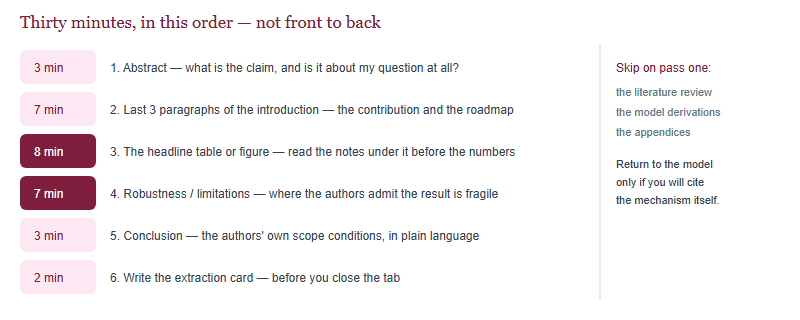
Two steps deserve explanation, because they are the ones students skip.
Step 3: read the table notes first. Underneath every results table sits a paragraph in small type telling you the sample, the period, the units, what the controls are, and what the stars mean. That paragraph is where the paper tells you whether its finding is about 800 firms or 8 million workers, about 2019 or about 2023. Read the numbers without it and you will misquote the study — one of the easiest ways to lose evidence marks while appearing well-researched.
Step 4: the limitations section is your best friend, not the boring part. This is where authors state the scope conditions of their own result. For a competition essay it is doubly valuable: it stops you overclaiming, and it hands you a ready-made, properly grounded objection for your critical-engagement paragraph. Conceding a limitation the authors themselves flag is one of the safest ways to look like a careful reader.

From a paper to 40 words of essay: the extraction card
Never close a paper without recording it. Two minutes now saves an hour of re-reading in the last week, and it prevents the error that ruins referencing scores — a citation whose page number, year or version you can no longer reconstruct.
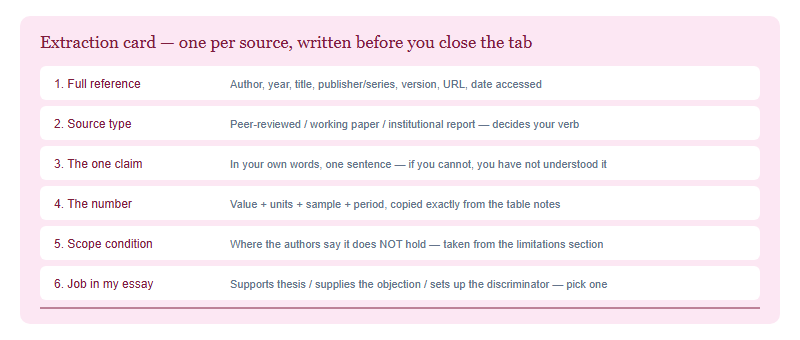
Field 6 is where most reading time is wasted or saved. If you cannot state the job a source does — supports the thesis, supplies the objection, or supplies the discriminator that settles between them — it is background reading, not evidence, and it should not consume any of your 1,500 words. Our guide to writing the essay sets out how those words are budgeted.
Three traps that show up in the drafts we review
- The literature-review trap. Three sources named in one sentence, none used. This reads as coverage, not thought, and it drains the originality band because a summary of other people's findings contains none of yours. One paper used properly beats five paraded.
- The abstract-only citation. Quoting a headline result you never verified in the table. Two risks: abstracts round and simplify, so your number may be wrong; and the abstract never carries the scope conditions, so you will overclaim. A marker who knows the paper sees this instantly.
- The vintage problem. A statistic that was current when a textbook was written and is now several revisions old, or a working-paper figure superseded by the published version. Always record the year and version on the extraction card, and prefer the most recent authoritative edition — then say which edition you used.
A realistic three-source diet for 1,500 words
Students routinely ask how many sources an essay of this length “should” have. The competition does not publish a required number — confirm any formal requirements on lsesuesec.org — but the word budget answers the question for you. At 1,500 words, a genuinely used source costs 40 to 80 words: the claim, the number with its units, and the inference you draw. Four used sources is therefore 160 to 320 words, and that is before your own argument.
A workable distribution for the last three weeks:
- One load-bearing empirical source that your central claim rests on. Read it fully with the triage order. Know its sample, period and limitations well enough to answer a question about them.
- One source for the opposing view, so your critical-engagement paragraph attributes a real objection rather than inventing a strawman.
- One contextual or comparative source — typically an institutional report — that establishes scale, or lets you extend the argument to a setting the original study did not cover.
Three sources, each doing a distinct job, will out-read a bibliography of twelve every time. If you are still deciding how your evidence fits the competition's criteria, start from our overview of what the LSESU Essay Competition is and how essays are assessed, then come back and run the triage order on your one most important paper tonight.
Frequently asked questions
Can I cite a working paper that has not been peer-reviewed?
Yes, if you signal its status: “a 2025 working paper reports…”. Do not present unreviewed results as settled findings, and check whether a later version exists.
How many sources does a 1,500-word essay need?
The competition publishes no fixed number — confirm on lsesuesec.org. In practice three genuinely used sources fit the word budget; more usually means listed, not used.
Should I read the mathematical model section?
Only if you will cite the mechanism itself. On a first pass, the results table and the limitations section carry far more usable material for a competition essay.
Is it acceptable to cite a research summary column instead of the paper?
Use summaries to find and understand papers, then cite the underlying study. Summaries omit the scope conditions your argument needs.
Published by the editorial desk of this site, operated independently by Hanlin International Education (翰林国际教育) for China-based international-school students. This site is not the official competition website and is not affiliated with the LSESU Economics Society or the London School of Economics. Official rules are set by the competition and change yearly, so always confirm current details on the official site lsesuesec.org. Confirmed errors are corrected within 7 working days.