One Essay, Two Deadlines: Choosing Between Marshall (30 Aug) and LSESU (1 Sep) in 2026
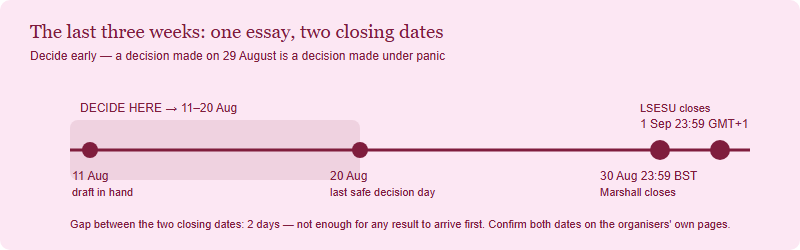
The Marshall Society competition closes on 30 August 2026. The LSESU Economics Society Essay Competition closes on 1 September 2026 at 23:59 GMT+1. Two days apart — and the Marshall briefing we work from bars essays entered in another competition at the same time. So if you are sitting on one strong economics essay in late August, you are not double-entering. You are choosing, and you have about three weeks to choose well.
Why a two-day gap forces a decision instead of offering a bonus
Most students discover these two competitions in the same week and assume the obvious move: polish one essay, send it to both, double the chance of a result. It looks free. It is not.
Three things close that door. First, the rule itself: the Marshall guidelines as our lead economics coach summarised them on 9 August state that entries submitted to any other competition at the same time are not accepted. Second, the arithmetic: with Marshall closing on 30 August and LSESU closing on 1 September, there is no window in which one entry has been judged, returned, or released before the other closes. Third, neither route lets you take it back — the LSESU rules are clear that there is no revision after submitting, and the Marshall briefing says the same about edits once the form is in.
The honest framing, then, is this: your essay is a single asset with one shot this season, and the value of that shot depends on how well the essay matches the brief you send it to. That is a fit problem, not a luck problem — and fit is something you can actually assess in an afternoon.
What the two briefs actually ask for, side by side
These are not interchangeable competitions wearing different university crests. They ask for different things, screen differently, and reward slightly different habits. Read the row that matters most to your essay, not the whole table at once.
| Marshall Society (Cambridge) | LSESU Economics Society | |
|---|---|---|
| Organiser | Cambridge University's economics society, founded 1927 | The LSE Students' Union Economics Society |
| Closing date | 30 August 2026, 23:59 BST; the briefing states there is no late marking | 1 September 2026, 23:59 GMT+1; late submissions are not accepted |
| Registration | Entry is through the official form; confirm any prior steps on the organiser's page | None. No prior registration, no candidate ID, questions are public |
| Questions | Six titles in 2026, including tariffs in historical and recent context, central banks against energy shocks, Britain leaving the gold standard in 1931, an evaluation of Andy Burnham's policies in Greater Manchester, whether the stock market indicates growth, and whether economics is a distinct discipline | Five questions; you answer one. See our 2026 prompts and rubric guide |
| Referencing | APA author-date, with a source list at the end (per the briefing) | Harvard referencing is the recommended style |
| Layout | Times New Roman 12, 1.5 spacing, page numbers; first page carries question number, title, author name and school | 12pt Times New Roman, 1.5 spacing, page numbers |
| File and route | PDF through the official Google form only; the briefing says email submissions are refused; file named as name plus question number; 10MB ceiling | Submit directly at lsesueconsoc.org/competitions/; file named FORENAME SURNAME (uppercase) + Question X |
| After you submit | No edits once submitted (per the briefing) | No revision or replacement once submitted |
| Generative AI | Permitted for research, per the briefing; the writing must be your own; every use must be declared on the submission form; entries pass similarity and AI-text screening, with disqualification for breaches | The official page states plagiarism and AI-generated content are strictly forbidden, and that entries are screened for both before judging |
| Length | Tight. Our own briefings disagree on the exact figure and the official page did not carry it when we checked — confirm on the page and form before you write | Maximum 1,500 words, excluding references |
| Stated judging emphasis | Logical argument, quality of evidence, originality (per the briefing) | Published criteria including argument, theory, evidence, critical engagement, structure, citation and relevance |
Two rows deserve a second look because students routinely get them wrong. The AI row is the sharpest difference in the table: one route describes a declared-research allowance, the other states a prohibition on AI-generated content. Do not carry an assumption from one brief into the other. And the length row matters because a 1,500-word ceiling excluding references is not the same instrument as a limit that may count footnotes — the second forces you to move commentary into the body rather than hiding it below the line.

The exclusivity clause, read carefully
The clause our briefing describes bars essays submitted to another competition at the same time. Students ask three sensible questions about it.
- Does it apply to an essay I entered last year? The wording our briefing gives is about simultaneous entry. Anything about a previous season is a question for the organiser, not for us to guess at — ask before you assume.
- What if I rewrite it substantially? A genuinely different essay answering a different question is a different essay. But a light rewrite of the same argument, the same evidence and the same structure is the thing the clause exists to catch, and both routes run similarity screening. Do not build a plan on a technicality you would be uncomfortable explaining out loud.
- What if I read the clause differently? Then check it on the organiser's own page and form before you rely on any reading, ours included. Note that even a reader who takes the most permissive interpretation still faces the timing problem: two deadlines two days apart, no revision after submitting, and one essay's worth of editing attention to spend. The choice is real either way.
A fit test: five questions about your essay, not about the competitions
Stop comparing prestige. Compare your draft against each brief. Five diagnostics do most of the work.
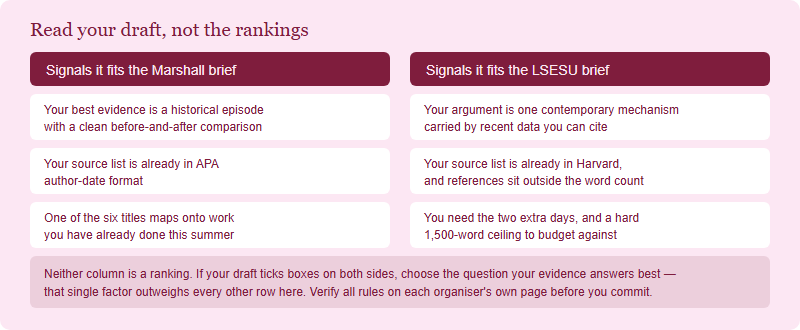
1. Which question does your evidence actually answer? This is the decisive one and it is usually settled before you start comparing. If your best material is a historical episode with a clean before-and-after — the kind of thing a gold standard or tariff question rewards — that is a Marshall-shaped essay. If your material is a contemporary mechanism argued through recent data, look hard at where it sits among the five LSESU questions.
2. Is your argument narrow or panoramic? A tight limit punishes breadth in both places, but the LSESU ceiling of 1,500 words excluding references is a known, hard number you can budget against today. If your draft is currently 2,400 words and every paragraph feels load-bearing, you have a scoping problem to solve before any submission decision — see our structure and method guide.
3. How did you use AI, if at all? If you used a generative tool anywhere in the process, the two routes treat that differently and you must be honest about which regime your working method fits. Do not send an essay into a route whose stated rules your process does not satisfy.
4. What is your referencing already in? Converting a full source list between styles at 11pm on 29 August is exactly the kind of avoidable error that costs presentation marks. If your draft is already in Harvard, that is a small point in the LSESU column; if it is in APA, the reverse.
5. Which route can you actually complete calmly? Term restarts in mid-to-late August at many international schools in China. Count your genuinely free evenings between now and each date, not your calendar days.
Three situations we see every August
The student with a finished essay on central banks and energy shocks. Both sets of questions touch this territory in 2026, which feels like luck and is actually a trap: the two titles are worded differently, and an essay tuned to one wording will read as slightly off-target against the other. Re-read both titles word by word, decide which one your thesis sentence already answers without modification, and go there. Do not send a near-miss because the deadline is friendlier.
The student who has written 1,900 words and loves all of them. Your problem is not competition choice. Cut first, choose second. A 1,900-word draft compressed properly usually reveals which argument was actually carrying the essay, and that often changes which question it best answers. Cutting also removes the temptation to pick a route on the basis of a length rule you have not confirmed.
The student who has an outline and no draft on 20 August. Be realistic. Writing one publishable competition essay in ten days while term restarts is hard; writing two is not a plan. Pick the single question you can defend with evidence you already have, and give it every remaining evening. Finishing one essay well is worth more than half-finishing two.
What to do this week
- Read both official pages yourself, today. Rules change year to year. Our summary of the Marshall rules comes from a briefing dated 9 August 2026; treat it as a starting point and confirm the current wording, especially on length, AI declaration and simultaneous entry.
- Write your thesis sentence on one line, then place it under each candidate title. The one it answers without editing is your competition.
- Decide by around 20 August. Then spend the remaining days editing for the brief you chose — layout, referencing style, first-page requirements, file name — rather than hedging between two.
- Do not enter both. If you are new to the LSESU route, start with what the competition is and how it works before you commit an essay to it.
- Keep your research notes. Whichever way you go, the reading behind the essay is reusable next season; the essay itself is not.
One last note on tone, since this site is an independent guide to the LSESU competition and you should read this with that in mind. The Marshall competition is a serious, long-established contest run by a society founded in 1927, and for the right essay it is the right home. We are not going to pretend otherwise, and we would rather you sent a well-matched essay elsewhere than a mismatched one to the LSESU competition. The point of this piece is that a deliberate choice made on 15 August beats a default choice made on 31 August — whichever way it goes.
Can I submit the same essay to both Marshall and LSESU?
The Marshall briefing we work from bars entries submitted to another competition at the same time. Confirm the current wording on the organiser's page.
When exactly does each competition close in 2026?
Marshall closes 30 August 2026, 23:59 BST. LSESU closes 1 September 2026, 23:59 GMT+1, and late submissions are not accepted.
How long can the LSESU essay be?
The official page states a maximum of 1,500 words, excluding references, for one essay answering one of the five questions.
Do I need to register for the LSESU competition first?
No. There is no prior registration and no candidate ID; the questions are public and you submit directly through the official portal.
Published by the editorial desk of this site, operated independently by Hanlin International Education (翰林国际教育) for China-based international-school students. This site is not the official competition website and is not affiliated with the LSESU Economics Society or the London School of Economics. Official rules are set by the competition and change yearly, so always confirm current details on the official site lsesuesec.org. Confirmed errors are corrected within 7 working days.