The First 150 Words and the Last 150: An Openings and Closings Clinic for the LSESU Essay (2026)
In a 1,500-word essay, your first 150 words and your last 150 words are roughly a fifth of the text — and they do far more than a fifth of the work. The opening decides how generously the rest is read; the closing decides what the reader carries away. Most competition drafts have a competent middle wrapped in a weak opening and a redundant ending. That is a fixable, high-return editing problem.
Why the bookends carry weight the middle does not
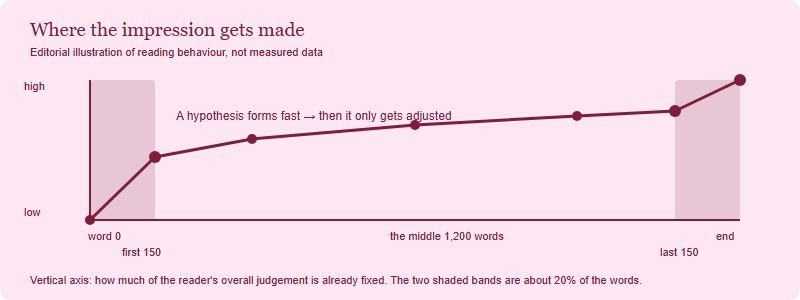
Think about what a marker is doing. They are reading many essays on the same five questions, written by students with broadly similar training, citing a broadly similar evidence base. By the end of your first paragraph they have formed a working hypothesis about your essay: whether you have understood the question, whether you have a position or only a topic, and whether the prose will be a pleasure or a chore. Everything after that is read against that hypothesis. A strong opening buys charity for a wobbly paragraph in the middle. A vague one means every later ambiguity is read as confusion rather than compression.
The closing works differently. By then the marker is not forming a hypothesis; they are consolidating a judgement. What a good closing does is make the consolidation land where you want it — on your specific claim and its limits, not on a generic restatement that could have topped any essay on the same question.
Note what this argument is not. It is not a claim about any published weighting. The criteria and their published breakdown live in our 2026 prompts and rubric guide; this piece is about craft at the level of two paragraphs. If your essay does not yet have a shape at all, fix that first with the structure and method guide — no opening can rescue an essay without an argument.
The four openings students actually write
Read almost any batch of competition drafts and the first paragraphs sort into four types. Only one of them consistently survives editing.
| Opening type | How it starts | What the reader concludes | Verdict |
|---|---|---|---|
| The dictionary | Defines the central term before doing anything with it: “Monetary policy refers to the actions taken by a central bank to…” | The writer is filling space, or is not confident the reader knows the subject. Neither impression helps. | Cut. Define terms at the moment you first need them contested, not before. |
| The panorama | Opens at civilisational scale: “Throughout history, societies have grappled with inequality…” | No position yet, and possibly none coming. Also: this paragraph would fit five different essays. | Cut. If a sentence could open any essay on the question, it is not your opening. |
| The signpost | Announces the structure: “This essay will first examine X, then discuss Y, before concluding.” | Organised, but has told the reader the running order rather than the argument. | Compress. One clause of signposting is fine; a whole paragraph of it is 60 wasted words. |
| The claim | Names the specific thing at stake and states a position on it in the first two sentences. | This writer has an argument, knows which part of the question is genuinely contested, and is going somewhere. | Keep and sharpen. This is the only type worth 120 words. |
One caveat before you delete everything. The panorama opening is not stupid — it is the transfer of a habit that is rewarded in school essays, where a wide opening funnel is often taught as good practice. In a 1,500-word competition essay, where the stated exclusion covers references only, that funnel costs you a full body paragraph. The genre has changed; the habit has not caught up.

Rebuilding the opener: a worked before-and-after
Here is a constructed example — our own writing, not a real entry — of a typical first paragraph on a monetary policy question, and what it looks like rebuilt.
Before (78 words, and it says almost nothing): “Monetary policy is one of the most important tools available to modern governments. Central banks around the world use interest rates and other instruments to influence the economy. In recent years, economies have faced many challenges, including energy price shocks, which have raised difficult questions for policymakers. This essay will explore whether central banks can stabilise their economies in these circumstances, examining both theory and evidence before reaching a conclusion.”
After (81 words, and it commits): “An energy shock is not one shock but two: it pushes prices up and output down at the same time, so any single interest-rate response makes one problem worse. That is the real constraint, and it is not a question of central-bank competence. This essay argues that stabilisation is achievable in the second year of such a shock but not the first, and that the binding factor is the credibility of the inflation target rather than the size of the rate move.”
Same length. The rewrite does four things the original does not: it names a specific mechanism, it identifies where the genuine difficulty lies, it commits to a position that could be wrong, and it tells you what the essay thinks the deciding variable is. A reader now knows what would count as evidence — and is inclined to read on to see whether you deliver it.
Three diagnostics you can run on your own first paragraph in five minutes:
- The deletion test. Delete your entire first paragraph and read from paragraph two. If the essay reads better or the same, your opening was scaffolding. Write a new one from the argument you actually made.
- The swap test. Could your opening sit on top of an essay arguing the opposite conclusion? If yes, it is describing a topic rather than making a claim.
- The stranger test. Give the first 150 words to someone who has not read the question. Ask them what you are going to argue. If they can only tell you the subject area, rewrite.
What a conclusion is actually for: four closing moves
The default conclusion restates the three body paragraphs in shorter sentences. This is the single most common waste of 150 words in competition writing, because the marker just read those paragraphs — the restatement adds no information and signals that you had nothing further to say.
A conclusion earns its place by doing one of four things. Pick one; attempting all four in 150 words produces mush.
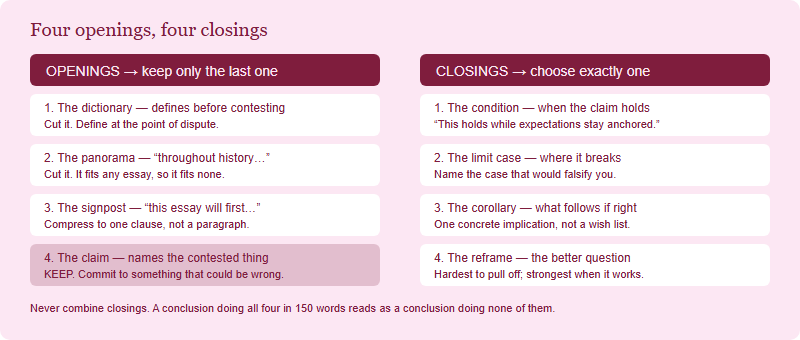
The condition. State the boundary inside which your claim holds. “Stabilisation works in the second year, provided the inflation target retains credibility; where it does not, the same policy produces the opposite result.” This is the safest strong ending because it demonstrates you understand your own argument's scope.
The limit case. Name the scenario that would falsify you, and say honestly what it would take to observe it. Far from weakening the essay, this reads as confidence — you have thought about where you are wrong, which is precisely the habit the critical-engagement criteria reward.
The corollary. Draw one specific consequence that follows if you are right and that the reader had not already inferred. Not “policymakers should consider this carefully” — that is filler. Something with a subject and a verb: which actor should do what differently, and why your argument implies it.
The reframe. Argue that the question as posed is the wrong cut of the problem, and name the better question. This is the highest-risk move: done badly it reads as dodging the prompt, and relevance is a published criterion. Attempt it only if your body paragraphs have already earned it by answering the question as asked first.
The last-line test
Read your final sentence alone, out of context. Then ask three questions.
- Is it specific to your essay? “Ultimately, the relationship between technology and inequality is complex and multifaceted” passes no test. It is true of everything and therefore says nothing.
- Does it hedge away the argument you just made? A remarkable number of drafts spend 1,300 words building a position and then retreat in the last line — “however, further research is needed”. If you believed your argument enough to write it, end on it.
- Does it introduce something new? A fresh statistic, a new author, a new mechanism in the final sentence is a structural error: the reader cannot evaluate it, and it makes the essay feel unfinished rather than open-ended.
A working rule: the last sentence should be the sentence you would say if someone asked you, in a lift, what you concluded and why. Say it in one clause, with the reason attached.
Budgeting the bookends inside 1,500 words
The official limit is a maximum of 1,500 words, excluding references. Within that, a workable allocation for the bookends looks like this — treat it as a starting point, not a rule, and adjust to your argument.
| Element | Typical spend | What it must contain |
|---|---|---|
| Opening | 100–140 words | The contested point, your position on it, and the deciding variable. Optionally one clause of signposting. |
| Body | 1,200–1,300 words | The argument, the evidence, and the engagement with the strongest objection. |
| Closing | 110–150 words | One of the four moves, executed fully, ending on a specific sentence. |
| References | Outside the count | Harvard style is recommended; because they sit outside the limit there is no reason to under-cite to save words. |
Two practical notes for the final fortnight. First, write your opening last, or rewrite it last — you cannot introduce an argument you had not finished making when you drafted paragraph one, and almost every strong opener we see is a retrofit. Second, edit the bookends on a separate day from the body. They demand a different kind of attention: the body rewards checking that each claim is supported, while the bookends reward reading aloud and listening for whether the sentence commits to anything. Do not try to do both in the same sitting at midnight on 31 August. If you are new to the competition's shape and rules, start with the overview of what the LSESU competition is before you start rewriting.
Should I write my introduction first or last?
Draft something to get moving, then rewrite it last. The strongest openings are retrofitted once you know what you actually argued.
How long should the conclusion be?
Around 110–150 words in a 1,500-word essay. Long enough for one closing move done properly, short enough not to restate the body.
Do references count toward the 1,500 words?
No. The official page states the maximum of 1,500 words excludes references. Harvard style is the recommended format.
Is it acceptable to end by admitting uncertainty?
Yes, if it is a stated condition or limit case. No, if it is a vague hedge that retreats from the argument you just spent the essay building.
Published by the editorial desk of this site, operated independently by Hanlin International Education (翰林国际教育) for China-based international-school students. This site is not the official competition website and is not affiliated with the LSESU Economics Society or the London School of Economics. Official rules are set by the competition and change yearly, so always confirm current details on the official site lsesuesec.org. Confirmed errors are corrected within 7 working days.