Running the LSESU Essay Competition as a School Activity: A Term Plan for Economics Teachers
A school cannot enter students into the LSESU Essay Competition, because there is no registration and no school account — students submit individually to a public set of questions. That removes the administrative work teachers expect and leaves the jobs that are genuinely yours: the calendar, the feedback capacity, and the integrity line. Each of them is decided in September, not in July.
What the school actually has to do, which is less than most departments assume
Departments planning their first cohort usually begin by asking who registers the school, how entries are submitted in bulk, and whether a teacher signs anything. In the 2026 cycle the answer to all three was: none of that exists. The questions were published openly, there was no registration and no candidate ID, and each student uploaded their own finished essay through the official portal before the stated deadline. Our overview of how the competition works sets out the entry route in full.
The absence of an administrative gate has one consequence worth stating to your department in week one: nothing in this competition will remind your students of anything. There is no confirmation of intent, no interim milestone, no email from an organiser two weeks out. A student who forgets simply does not enter, and no one finds out. Everything that keeps a cohort on track has to be built by the school.
So the department's job reduces to four things: publish an internal calendar that is earlier than the real one; build the writing and reading capability during term time, when you can actually teach; plan the feedback load before it arrives; and set the integrity rule clearly enough that no student has to guess where the line is.
The calendar collision that decides everything
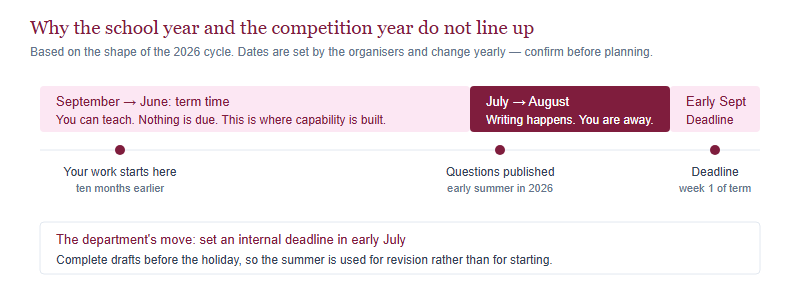
Here is the structural problem, and it is the reason most school cohorts underperform their ability. In 2026 the questions were public from early summer and the deadline fell on 1 September at 23:59 GMT+1. For a school in China, that arrangement puts almost the entire writing window inside the summer holiday, and puts the deadline itself in the first days of the new academic year — which in Beijing time meant the early morning of 2 September, when staff and students were preparing for a new term rather than finishing essays.
In other words: the period when students most need supervision is precisely the period when your department is unavailable, and the deadline lands in your busiest week. You cannot change that. You can only move your own work earlier than it.

A term-by-term plan
This plan assumes the 2027 cycle keeps roughly the shape of 2026. Confirm the actual dates and rules on the official site before committing your department — questions, deadlines and eligibility wording are set by the organisers and do change.
| Period | Departmental objective | What students do | Teacher time |
|---|---|---|---|
| Autumn term | Build the reading habit. This is the input the competition rewards and the one that cannot be produced quickly in August. | Read one short economics paper a fortnight and write a 150-word summary naming the mechanism, the evidence and the limitation | ~30 min a fortnight, in a club slot rather than a lesson |
| Spring term | Practise the format on a retired question, where the stakes are zero and the feedback can be blunt. | Write one 1,500-word essay on a previous year's question; mark each other's against the published criteria | Two sessions plus one round of written feedback |
| Early summer term | Decide who is actually entering, and get question choice settled fast once the questions appear. | Read the new questions the week they are published; commit to one within seven days | One 45-minute conversation per entrant |
| Late summer term | Get a complete draft finished before the holiday begins. This is the single highest-leverage rule in the plan. | Full draft to an internal deadline in early July, not a plan or an outline | The main feedback load — see the capacity section below |
| Summer holiday | Revision only, unsupervised, against a checklist students already understand. | Cut to length, verify figures, fix referencing, export and submit early | Optional: one asynchronous check-in in mid-August |
| New autumn term | Capture what was learned before it evaporates, and start the next cohort. | Twenty-minute written post-mortem; present the argument to the club | One session, which doubles as recruitment for the year below |
One scheduling warning for late August. This is a crowded period for economics essay competitions, and the clashes are not always compatible: in 2026 a comparable competition closed on 30 August and its rules barred an essay that had been submitted elsewhere at the same time, which forced students holding a single essay to choose between the two. Flag any such overlap to your cohort in the spring, while there is still time to write two different essays or to choose deliberately, rather than in the final week when the choice is forced.
Feedback capacity, and the integrity line
Departments underestimate this consistently, so do the arithmetic before you announce the activity in assembly. A useful drafting round is two reads per student — one on the argument, one on the execution — at roughly 25 minutes each if you are writing comments worth reading.
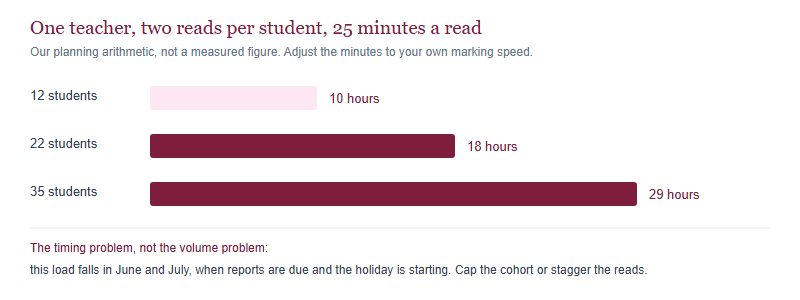
Three ways to make the load survivable, in order of how well they work. First, cap the cohort by requiring the spring practice essay as an entry condition — self-selection is fairer than a teacher choosing favourites and it halves the summer load. Second, put the first read into structured peer review against the published criteria, with your read reserved for the argument. Third, stagger internal deadlines across two weeks so twenty drafts do not arrive on the same evening.
What to tell students about the integrity line, in week one
The competition requires the work to be the student's own and screens submissions for plagiarism and for AI-generated text; the current wording of those rules, and the consequences attached to them, are published by the organisers and should be read directly rather than paraphrased from any summary, this one included. What a school can add is an internal rule that is easier to apply than a policy document.
The rule we would suggest is a single sentence: comment on the argument, never supply the sentence. Under it, a teacher can say that a claim is unsupported, that a paragraph does not follow from the one before it, that a model is being named rather than used, or that the conclusion does not answer the question. A teacher does not rewrite a sentence, supply a source the student has not read, or hand over a structure to fill in. The test is whether the student could defend every line as their own thinking, because in an interview that is exactly what they will be asked to do.
Say this in the first session rather than in June. Students who learn the boundary early write differently — they bring problems to you instead of bringing drafts for repair — and the drafts are better for it. It is also the honest answer to the parent who asks how much help is allowed.
Six club sessions that transfer beyond this competition
Everything below is worth teaching whether or not a student enters. That is the test we would apply before putting a session on the calendar: if the competition were cancelled tomorrow, would this session still have been worth an hour of a Year 12's time?
- Session 1 — Reading a paper in thirty minutes. Abstract, then results, then method. Students practise extracting one mechanism and one limitation, out loud.
- Session 2 — Turning a question into a task. Take a published question and identify what it obliges you to produce: a decision, a verdict, a set of measures. Most weak essays we see fail here, not at the writing stage.
- Session 3 — Making a model do work. The difference between naming a framework and using it to generate a prediction that could be wrong.
- Session 4 — The 1,500-word budget. Allocate the words before drafting. Our guide to structure and method works well as pre-reading for this one.
- Session 5 — Marking with the real criteria. Give students the published weightings and two anonymised drafts. Students who have marked once write differently forever; this is the highest-return session of the six.
- Session 6 — Defending it aloud. Five minutes to present the argument, five minutes of hostile questions from the room. This is interview practice disguised as an economics activity.
If you want the raw material for sessions 2 and 5, the 2026 questions and the published marking criteria are the best available teaching set — the questions change each year, but the 2026 criteria and question types remain a workable teaching frame until the new cycle publishes its own.
Frequently asked questions
Does the school need to register or submit on behalf of students?
No. In the 2026 cycle there was no registration and no school account; each student submitted their own essay directly through the official portal.
How much teacher feedback is allowed?
The work must be the student's own. A workable internal rule: comment on the argument, never supply the sentence. Confirm rules officially.
When should a school cohort actually start?
Autumn, ten months out. The reading habit is the input that cannot be manufactured in August, and it is what the criteria reward.
What is the single most useful thing a department can impose?
An internal deadline for a complete draft before the summer holiday begins, so the holiday is spent revising rather than starting.
Published by the LSESU Essay Competition editorial desk, operated by Hanlin Education for China-based international-school students. Official rules are set by the competition and change yearly — confirm current details on lsesuesec.org. Errors are corrected within 7 working days.