The Rigour Audit: Six Economic Reasoning Errors That Quietly Cost Marks in the LSESU Essay (2026)
Six reasoning errors do most of the quiet damage in LSESU essays: reading correlation as cause, ignoring how a sample selected itself, assuming a result travels, answering a whole-economy question with a single-market answer, mixing real with nominal, and asserting magnitude when you only know direction. None of them is a spelling problem. Each one weakens the argument, theory and critical-engagement marks — together the largest block on the sheet.
Why most of the marks depend on your reasoning, not your prose
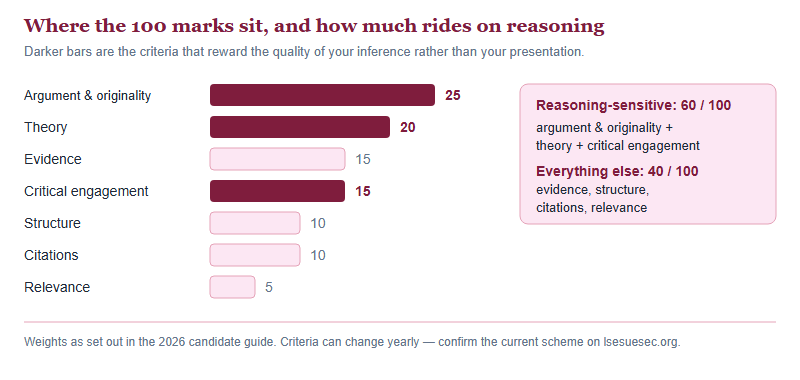
The 2026 candidate guide sets out a 100-point scheme across seven criteria: argument & originality 25, theory 20, evidence 15, critical engagement 15, structure 10, citations 10 and relevance 5. Our breakdown of the 2026 prompts and rubric walks through each one, and because the official guide can change from year to year, confirm the current version on lsesuesec.org before you rely on any weighting.
Read that scheme as a diagnosis rather than a scorecard. Three of the seven criteria — argument & originality, theory and critical engagement — are the ones most sensitive to whether the chain from premise to conclusion actually holds. Add them and roughly 60 of the 100 points are reasoning-sensitive, in an essay that can be fluent, well-referenced and perfectly formatted and still lose them. The 25-mark criterion is not purely a logic test, though — it rewards originality outright as well, which we cover in how to score 25/25 on originality. Structure and citations reward presentation. Argument, theory and critical engagement reward thinking, and they are unforgiving in 1,500 words because there is no room to bury a weak link under volume.
This is deliberately not a list of craft mistakes — running over the limit, thin referencing, a missing counterargument. Those are visible to anyone who rereads their own work carefully. The six errors below are different: they survive proofreading. The sentence reads beautifully, the citation is real, the source is respectable, and the inference is still wrong. Because the five prompts are public and there is no registration step, every entrant starts from the same material; what separates essays is exactly this layer.
Three errors that break a causal claim
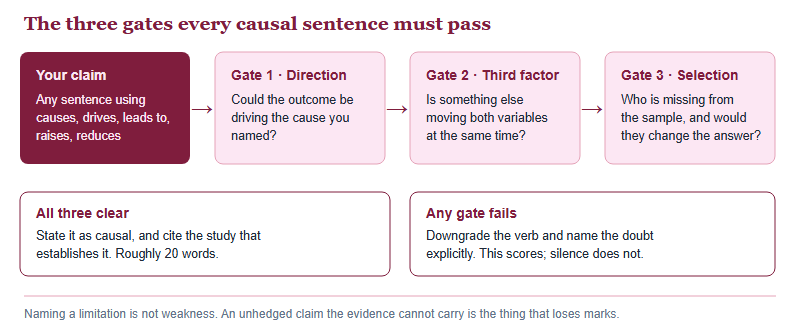
Error 1 — correlation wearing the costume of causation. The tell is a verb: firms that adopted hybrid work saw productivity rise, therefore hybrid work raises productivity. The first clause is an association, the second is a causal law, and nothing in between earned the upgrade. This matters in every one of the 2026 themes, because each of them is a live research question precisely because the causal direction is contested. The repair is not to delete the claim; it is to say what would establish it. One sentence — naming the comparison you would need, and admitting whether your source provides it — converts a weak assertion into visible critical engagement.
Error 2 — selection and survivorship. Your sample chose itself before you found it. Only the firms whose tasks could be done remotely went remote. Only the economies that got a green technology to commercial scale generate the case studies that get written up. Only workers still employed appear in the survey about how automation changed their job. A conclusion drawn from that sample describes the survivors, not the population, and a marker who has read the underlying literature will spot it instantly. The repair is a single clause naming who is missing.
Error 3 — the portability fallacy. An estimate from one country, one decade and one institutional setting is quoted as if it were a constant. A labour-supply response measured where unions are strong and mobility is low will not carry to an economy with the opposite features. This is the most common way strong students lose critical-engagement marks: the evidence is real, the citation is correct, and the transfer is unargued. The repair is to name two conditions under which the result would travel and say whether they hold in the case you are discussing.

Three errors that break the economics
Error 4 — a single-market answer to a whole-economy question. Several of the 2026 themes are general-equilibrium questions in disguise. Estimating the revenue from a higher top rate of tax by multiplying the new rate by today’s tax base assumes the base does not respond — no change in reported income, no change in effort, no relocation, no shifting between income and capital gains, and no change in what the revenue is then spent on. The same trap catches automation arguments that count displaced jobs in one occupation and stop before the labour released is reallocated, or before cheaper output raises demand elsewhere. You are not expected to solve a general-equilibrium model at school level. You are expected to notice that a second round exists, name its likely sign, and say whether it strengthens or offsets your first-round conclusion.
Error 5 — unit hygiene. Real versus nominal, level versus growth rate, stock versus flow, aggregate versus per capita. Every one of these is a marks-losing ambiguity, and energy and inflation material is where students slip most often: a nominal wage increase during an energy price spike is not a real income gain, and a fall in the inflation rate is not a fall in prices. Adopt a mechanical rule for the whole essay — every number you cite carries its unit, its year, and, where it is a monetary value, whether it is real or nominal. It costs three or four words per figure and removes an entire category of error.
Error 6 — sign without magnitude. “A carbon price reduces emissions” tells the reader the direction of an effect. Whether it reduces them enough to matter for the question you were asked depends on elasticities, coverage, substitution and time horizon. Weak essays stop at the sign and then draw a policy conclusion that only a large magnitude would justify. Strong essays state what magnitude the conclusion needs and whether the cited evidence supports one that big. That single move is often the difference between a competent essay and one that reads like economics.
Symptom, diagnosis, repair: a table to run against your draft
Work through your draft with this table open. The left column is the sentence pattern as it usually appears; the right column is the smallest edit that fixes it. Most repairs cost fifteen to twenty-five words, which is why they belong in the redraft rather than the first draft.
| Sentence pattern in your draft | What the marker sees | The repair move |
|---|---|---|
| “X rose and Y rose, so X caused Y” | Correlation upgraded without licence | Downgrade the verb, then name what would identify the effect |
| “Studies of firms that adopted it show…” | A self-selected sample | Add one clause on who is absent and which way that biases the result |
| “Evidence from country A shows this works” | Unargued transfer between settings | Name two conditions for transfer; say whether they hold here |
| “Raising the rate would raise revenue by…” | A static calculation on a responsive base | Add the behavioural response and its sign in one sentence |
| “Wages rose by N% last year” | Unit ambiguity: real or nominal? | Attach unit, year and real-or-nominal to every figure |
| “Inflation fell, so households are better off” | Growth rate confused with level | Separate the rate of change from the level it acts on |
| “The policy reduces emissions, so it should be adopted” | Sign used where magnitude is needed | State the magnitude the conclusion requires and test it |
| “Some argue the opposite, but this is unconvincing” | A counterargument dismissed, not engaged | Give the strongest version of it, then answer that version |
A 30-minute rigour audit on your own draft
Do this once, on a printed copy or with track changes on, after the structure is settled and before you start polishing sentences. It is a reading exercise, not a rewriting one — you are marking up problems now and fixing them in a single later pass, and it belongs inside the wider sequence set out in the final edit: a three-pass redraft.
- Minutes 0–8 · Find the causal verbs. Highlight every instance of causes, drives, leads to, results in, boosts, raises, reduces, forces. In a 1,500-word essay most students find between eight and fifteen. That number is your workload.
- Minutes 8–15 · Run the three gates. For each highlighted sentence, mark it K (keep as causal, evidence supports it), H (hedge and name the doubt) or D (delete; it is decoration). Expect most to become H. Two or three well-defended causal claims beat a dozen assertions.
- Minutes 15–23 · Audit every number. Circle each figure and check it carries unit, year and real-or-nominal status, and that the sentence around it distinguishes level from rate of change.
- Minutes 23–30 · Attack your own thesis. Write one sentence describing the condition under which your central claim fails. If you cannot produce one, the claim is not yet an argument — it is a position, and the critical-engagement criterion is designed to catch exactly that difference.
Budget the words before you start editing. Hedging done properly costs roughly fifteen to twenty-five words per claim, so converting five assertions into defended claims can cost a hundred words you have to find elsewhere. Our guidance on how to write the essay shows where that space usually hides — normally in a long introduction or a second example doing the same job as the first.
Timing matters this week. The deadline is 1 September 2026 at 23:59 GMT+1, which leaves roughly five weeks, and an essay cannot be revised or replaced once it has been submitted. That makes the rigour audit a pre-submission step, not an afterthought; our final-month plan shows which week to run it in. If you are still getting oriented, start with what the LSESU Essay Competition is and how to enter, then confirm every entry rule on lsesuesec.org — remember there is no registration and no candidate ID; the prompts are public and finished essays go directly to lsesueconsoc.org/competitions/.
Frequently asked questions
Does hedging my claims make the essay look weak?
No. A named limitation reads as control and earns critical-engagement marks. The weak move is an unqualified claim your evidence cannot carry.
How many causal claims should a 1,500-word essay make?
Usually two or three, each properly supported. A long list of unsupported assertions scores worse than one chain of reasoning defended well.
Do I need econometrics to write about causation?
No. You need to name what would identify the effect and say honestly whether your source does that. School-level language handles this fine.
Where do I check the marking criteria?
Our 2026 prompts and rubric piece sets them out, but the official guide on lsesuesec.org is the version that counts and can change each year.
Published by the editorial desk of this site, operated independently by Hanlin International Education (翰林国际教育) for China-based international-school students. This site is not the official competition website and is not affiliated with the LSESU Economics Society or the London School of Economics. Official rules are set by the competition and change yearly, so always confirm current details on the official site lsesuesec.org. Confirmed errors are corrected within 7 working days.