Writing About China in the LSESU Essay: How to Use Asian Evidence for a London Reader (2026)
A China or wider-Asia case study can lift an LSESU essay well above the recycled Anglo-American examples markers see every season — but only on three conditions: the source is checkable in English, the case demonstrates a mechanism rather than decorating a paragraph, and you state what it does not show. Novelty on its own earns nothing. Verifiable evidence used analytically is what the marking scheme actually rewards.
Why an Asian example helps, and the condition attached
The five 2026 questions are public and there is no registration step, so a large international field is working from the same prompts and, very often, the same reading lists. That produces a predictable evidence base: the same handful of American firm-level studies, the same European policy episodes, the same three graphs. An entrant writing from Shanghai, Shenzhen or Singapore has access to a different set of cases — and a genuinely different case is the cheapest source of originality available to you.
The condition is that the marker must be able to check it. Under the 2026 scheme, evidence carries 15 of the 100 marks and critical engagement another 15, with argument at 25 (see the 2026 prompts and rubric, and confirm the current criteria on lsesuesec.org). None of those criteria reward the geography of your example. They reward whether the evidence supports the inference you drew from it. An unverifiable statistic, however striking, is dead weight: a marker who cannot open your source cannot credit it, and may reasonably discount the paragraph that rests on it.
There is also a failure mode specific to this material, and it is worth naming before you draft. Students sometimes argue that an Asian economy is so distinctive that standard analysis does not apply to it. That is not an insight; it is an unargued claim about scope conditions, and it usually loses critical-engagement marks rather than gaining them. The stronger move is the opposite: show that the same mechanism operates, then identify precisely which parameter differs — the share of employment in tradable manufacturing, the degree of labour mobility, the energy import share, the structure of the tax base — and follow that difference through to your conclusion.
The verifiability ladder: what a marker can actually check
Before you cite anything, place it on this ladder. The rule is simple: any claim that carries weight in your argument belongs in the top three tiers. Reserve the bottom tier for colour, and label it as reporting when you use it.
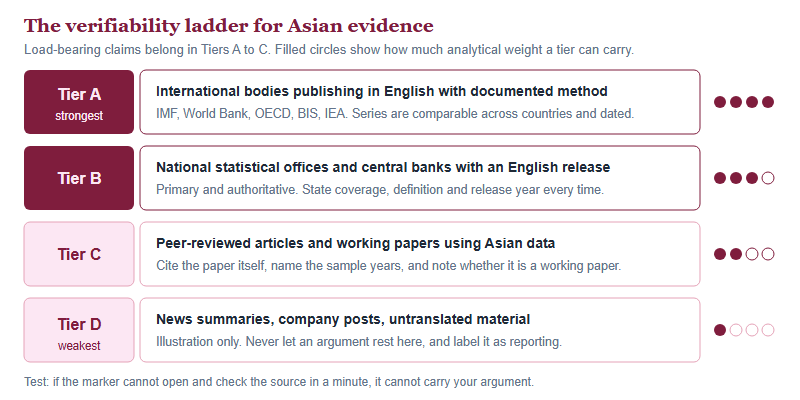
Two practical habits follow from the ladder. First, prefer sources with a stable English reference — a report title and year, a working-paper number, a DOI — over a link that may not resolve for a reader outside your school network. Second, when the primary release exists only in Chinese, cite it properly and pair it with an accessible English series covering the same variable, so the marker can verify the magnitude even if they cannot read the original. Harvard-style referencing is recommended in the official guidance, and our Harvard-style referencing and academic-integrity guide works through the formats in detail; check the current formatting requirements on lsesuesec.org before you build your reference list.
A useful discipline before you draft any paragraph built on an Asian case is to assemble three sources rather than one. Take a Tier A or Tier B series for the magnitude, so the number is comparable and dated. Take a Tier C paper for the mechanism, so you are borrowing an argued causal channel rather than inventing one. Then take one datapoint that cuts against your reading, because the essay needs it and because looking for it will tell you quickly whether your case is as clean as it first appeared. Three sources per case, not eight: at 1,500 words you cannot afford a literature review, and a reference list padded with items you never used is transparent to a marker. Our guide to using evidence and data (and passing the AI screen) covers what happens to those sources once they are inside the draft.

One example, four jobs: the 180-word case-study anatomy
The most common way a good example is wasted is length without function. A student spends 250 words narrating what happened in a particular market and never converts the narration into analysis. Give every case study four jobs and a word budget, and it will earn marks under both evidence and critical engagement at the same time.
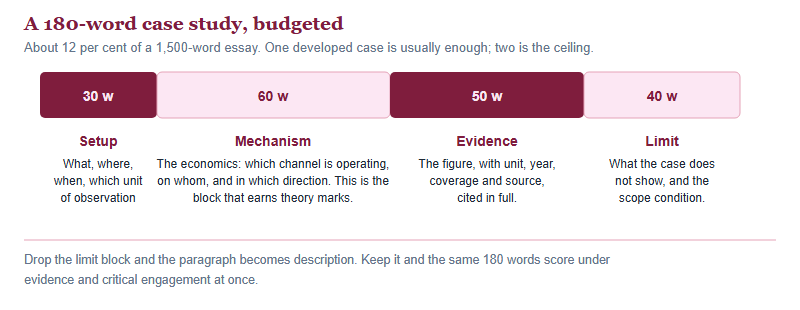
The limit block is the part students cut when they run out of words, and it is the most valuable forty words in the paragraph. “This is establishment-level data and therefore says nothing about workers who left the sector” is worth more than another sentence of narration. Our guide to how to write the essay shows where these blocks sit inside the overall structure so the case does not swallow your argument.
If the four blocks feel abstract, draft them as sentence stems first and fill in your own material afterwards. Setup: “In [economy], [unit of observation] between [years]…” Mechanism: “The channel is [price, quantity, expectation or constraint], operating on [whom], because…” Evidence: “[Figure, unit, coverage, year] ([source, release year]) is consistent with that channel because…” Limit: “This does not establish [the stronger claim], because the data cover [scope] and exclude [who or what].” Four sentences, roughly 180 words once expanded, and the paragraph already carries a mechanism, a verifiable number and an honest boundary. Write the limit stem before the evidence stem if you can; it stops you selecting a figure that only appears to support you.
Translation, units and naming hygiene
Most of the marks lost on Asian material are lost to ambiguity, not to error. The figure is right; the reader cannot tell what it refers to. Apply the checks below mechanically, once, near the end of your redraft.
| Item | The ambiguity it removes | What to write |
|---|---|---|
| Currency | Is this RMB or a conversion, and on what basis? | Keep the original currency and state the year; if you convert, name market rates or PPP |
| Geographic coverage | National, provincial or one city? | Name the level explicitly; never let a city figure stand in for a country |
| Definitions | Urban, registered, migrant, formal sector? | Quote the definition used by the release, in six words or fewer |
| Institution names | Is this body identifiable to a London reader? | Use the organisation’s own English name at first mention, then abbreviate |
| Policy names | What does the programme actually do? | Give the official English rendering plus a one-clause gloss of the instrument |
| Vintage | Which release, and has it been revised? | Cite the release year alongside the reference year of the data |
| Comparability | Can this sit next to a UK or US figure? | Use a harmonised international series when comparing across countries |
| Register | Is this measurement or commentary? | Attribute opinion to its author; keep statistics and interpretation in separate sentences |
Matching Asian evidence to the 2026 themes
Each of the five questions was set by an LSE economist around a live research area, and most of the five have an Asian angle that genuinely tests the argument rather than ornamenting it. Read the questions themselves in the 2026 prompts and rubric before you commit — the wording, not the theme, is what you must answer — and if you are still choosing between them, which of the five questions to pick works through the trade-offs.
- Remote work and monitoring. Task composition differs sharply between economies with a large tradable-manufacturing base and service-dominated ones. That difference is a scope condition you can argue with, not a curiosity. The trap is generalising from a handful of large technology employers whose jobs were remote-capable to begin with. Mind the scope, too: the question asks what a single firm should do, so cross-country task composition is context for that firm’s choice, not the unit of analysis.
- Monetary policy after an energy shock. Energy import dependence, the pass-through from wholesale to retail prices, and the presence of administered prices all vary across Asia, and each changes what a central bank optimally does. Note, though, that this question is written as a brief to the Bank of England on UK energy prices — Asian evidence belongs here only as a comparison that sharpens the UK recommendation, never as a substitute case. The trap is comparing headline inflation rates across countries whose energy pricing regimes differ without saying so.
- AI, jobs and inequality. Adoption sequencing differs: some economies automated routine manufacturing tasks well before office tasks became exposed. The trap is treating one occupational category as the whole labour market.
- Taxing the top of the distribution. The mobility of the tax base and the mix of labour versus capital income shape any behavioural response. The trap is importing an elasticity estimated in one tax system into a different one without argument.
- Green technology and inequality. Manufacturing scale, deployment and consumption are distributed very differently across countries, and the distributional question depends on which of the three you mean. The trap is sliding between them inside one paragraph.
Whichever you choose, one discipline holds. Every claim about a country needs a source a marker can open, a year, and a stated limit. If you are still deciding how the whole thing fits together, start with what the LSESU Essay Competition is. Entry itself stays simple, and our page on how to enter sets out the steps: no registration, no candidate ID, prompts public, finished essay submitted directly at lsesueconsoc.org/competitions/ before 1 September 2026, 23:59 GMT+1 — with about five weeks left, choose your case now and spend the remaining time making it work.
Frequently asked questions
Will writing about China make my essay stand out?
Only if the case tests your argument. A fresh example still needs a mechanism, a source the marker can check and a stated limit.
Can I cite Chinese-language sources?
Yes, but pair them with an accessible English series covering the same variable so a marker can verify the magnitude without translating.
Should I convert RMB figures into pounds or dollars?
Either works if you state the basis: currency, year, and whether you used market exchange rates or PPP. Unlabelled conversions read as careless.
How many examples fit into 1,500 words?
Usually one developed case plus a short contrast. A third example normally repeats work already done and costs words your analysis needs.
Published by the editorial desk of this site, operated independently by Hanlin International Education (翰林国际教育) for China-based international-school students. This site is not the official competition website and is not affiliated with the LSESU Economics Society or the London School of Economics. Official rules are set by the competition and change yearly, so always confirm current details on the official site lsesuesec.org. Confirmed errors are corrected within 7 working days.