Writing Economics in English as a Second Language: A Style Clinic for the LSESU Essay (2026)
Nothing in the LSESU marking scheme rewards native-speaker fluency. What it rewards is a legible argument — and unclear English hides one. Six sentence-level patterns cause most of the damage for writers working from Chinese into English: nominalisation stacks, empty subjects, article slips, overloaded sentences, tense drift when citing research, and hedges that do not match the evidence.
What is marked, and what is not
The 2026 criteria distribute 100 points across argument, theory, evidence, critical engagement, structure, citations and relevance, as set out in the 2026 prompts and rubric. There is no criterion for native-speaker fluency or idiom — markers are reading for economics, not for accent. But clarity is marked directly: Structure & Clarity is worth 10 marks, and its descriptor explicitly names precise language. Confirm the current criteria on lsesuesec.org, since the scheme can change from year to year.
So unclear English costs you twice: once under that criterion, and again by hiding the economics the other 90 marks are awarded for. Every mark on that sheet is awarded for something the marker can see. If a sentence carrying your central mechanism takes three readings to parse, the mechanism is not visible, and the marks that depend on it are not available — not because your English was punished, but because your economics went unread. In a 1,500-word essay the effect is sharp: at roughly 60 to 75 sentences in total, a dozen unclear ones is a sixth of your argument obscured.
The good news is that this layer is the most fixable part of the whole essay. Argument quality takes weeks to improve. The six patterns below can be cleared in about an hour, and they are the same six every season. Do the work after your structure and evidence are settled — as our guide to how to write the essay sets out, polishing sentences you are about to delete is the least efficient hour in the process.
Six patterns that blur an economics argument
These are patterns, not errors of vocabulary. Each one is grammatically defensible and still costs clarity, which is why spellcheckers never flag them.
| Pattern | Typical draft sentence | Tighter version |
|---|---|---|
| 1 · Nominalisation stack Actions turned into nouns |
“The implementation of a reduction in the tax rate resulted in an increase in investment.” | “Cutting the tax rate raised investment.” Ten words saved, mechanism visible. |
| 2 · Empty subject No agent doing the acting |
“It can be seen that there are many factors which influence wages.” | “Three forces move wages in this market: bargaining power, task composition and outside options.” |
| 3 · Articles and countability Mass nouns given articles |
“The inflation reduced the real income of the households.” | “Inflation reduced real household income.” Use “the inflation rate” only when you mean the measured rate. |
| 4 · Overloaded sentence Three claims, one full stop |
“Automation may replace some jobs and it also creates new jobs, but the net effect is unclear and it depends on the sector.” | “Automation displaces some tasks and creates others. The net effect depends on the sector, and the evidence remains mixed.” |
| 5 · Tense drift when citing Argument and finding blurred |
“Author (2020) argue the effect was small and finds it is large in services.” | Present for a standing argument, past for what a study did: “Author (2020) argues X; the study found Y over 2005 to 2015.” |
| 6 · Decorative connective Links that carry no logic |
“Moreover, government spending increased. Furthermore, output rose.” | “That rise in government spending offset the fall in private demand, so output recovered.” |
Pattern 6 deserves a note, because it is the one students defend. Chains of “moreover”, “in addition” and “furthermore” feel like signposting, but they only tell a reader that another sentence has arrived. Logical connectives — because, so, by contrast, which implies, the exception is — tell the reader how two ideas relate, and that relation is the argument. Swapping decorative links for logical ones is one of the fastest ways to make analysis visible without adding a word.
Pattern 3 deserves a rule rather than case-by-case guesswork, because it is the single most frequent slip in economics writing from Chinese. Four rules cover most of it. Economic abstractions used in general take no article: inflation, unemployment, output, welfare, capital, trade. The same words take “the” once you have specified which instance you mean: the inflation rate, the unemployment rate in that year, the output of the sector. Plural countables used generally also take no article: firms respond, households save, markets clear. And institutions take “the” when the name is descriptive — the World Bank, the Bank of England, the IMF — but not when it is a standalone proper name. Fifteen minutes applying those four rules will clear most of the article errors in a typical draft, and unlike vocabulary, they are learnable in one sitting.

The hedging ladder: matching your verb to your evidence
Non-native writers tend to sit at one of two extremes: either everything “proves” something, or everything “may perhaps to some extent suggest” something. Neither reads as economics. Academic register is calibrated — the strength of the verb should be exactly the strength of the evidence behind it, and a marker reads that calibration as expertise.
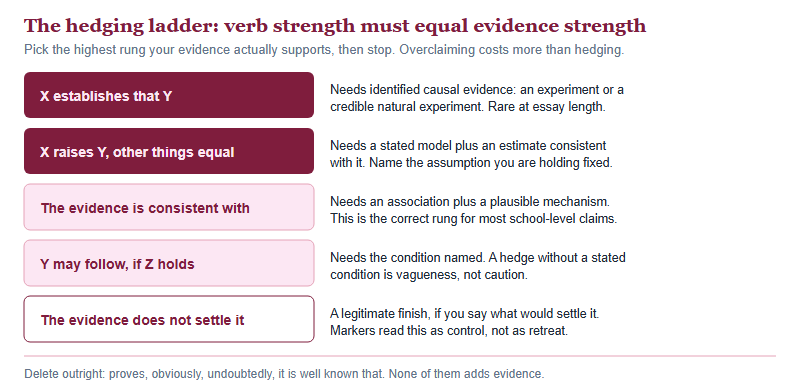
Two further register habits help. Cut intensifiers that pretend to be measurement — “very significant”, “greatly increased”, “extremely important” — and replace them with the magnitude itself or with nothing. And avoid rhetorical questions, which read as filler in a 1,500-word analytical essay; convert each one into the statement it was hinting at.
Topic sentences that survive a fast read
Assume your marker reads the first sentence of every paragraph first, then goes back for detail. That is not laziness; it is how experienced readers navigate. So run the first-line test on your own draft: copy the opening sentence of each paragraph into a separate document, in order, and read only those. Six or seven sentences should reconstruct your entire argument, including the counterargument and the conclusion.
If the sequence reads as a list of subjects — “This paragraph considers the labour market”, “Next, the fiscal side” — your essay is organised by topic rather than by argument, and structure marks will reflect that. A topic sentence should make a claim you could disagree with: “The labour-market effect is smaller than the headline figure implies, for two reasons.” Then the paragraph proves it. This single test takes about ten minutes and catches structural problems that a paragraph-by-paragraph read will not.
When the test fails, the repair is usually promotion rather than rewriting. Somewhere inside the paragraph — often the third or fourth sentence, written after you had finished thinking your way through the point — sits the claim the paragraph actually makes. Move that sentence to the front and delete the preamble it displaced. The edit costs nothing and typically saves fifteen to twenty words, which is exactly the space a hedge or a limiting clause needs. Do this for every paragraph that opens by announcing a subject, then read the first lines in sequence again to confirm the argument now holds without the body text.
A one-hour language pass that never touches your argument
This pass is the last stage of a longer redraft, not a substitute for one: the final edit, a three-pass redraft, runs the argument audit first and evidence and referencing second, and the line edit below is its third pass. Do these four sweeps separately. Doing them together is why editing feels endless: your attention cannot hold six patterns at once, and each sweep is faster when you are hunting only one thing.
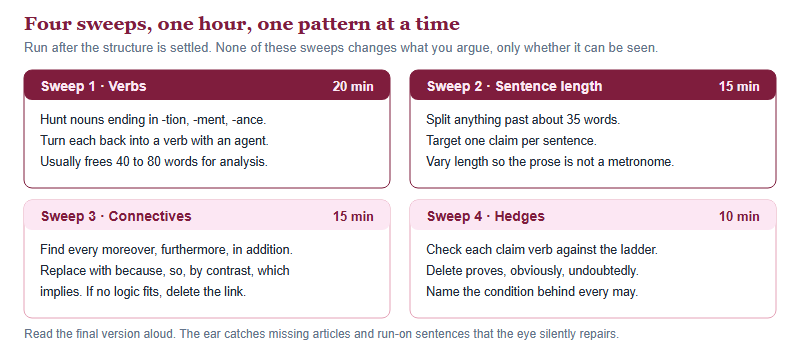
One caution on tools. Entries are screened for plagiarism and for generative-AI use, and breaches are treated seriously, so the argument, the structure and the sentences must be yours. Our guide to referencing and academic integrity works through where that line falls in practice, including what counts as acceptable help. Do not use generative tools to draft, rewrite or translate passages of your essay. If you are unsure whether a particular piece of software falls the right side of the line, the rules published on lsesuesec.org are the authority — check before you use it, not afterwards. Reading aloud, changing the font, and printing the draft remain the most reliable proofreading methods available to a second-language writer, and none of them raises a question about authorship.
Timing, finally. Entry has no registration step and no candidate ID, as our page on how to enter sets out: the prompts are public and you submit the finished file yourself at lsesueconsoc.org/competitions/ by 1 September 2026, 23:59 GMT+1 — which is 06:59 on 2 September in Beijing, though you should confirm the deadline and time zone on the official site rather than rely on arithmetic. That leaves roughly four and a half weeks, and an essay cannot be revised once it has been submitted, so schedule the language pass for the week before you upload rather than the night of, and keep the submission checklist on file naming and format open for the upload itself. If you are new to the competition, the overview of what it involves is the place to start.
Frequently asked questions
Do markers penalise non-native English?
The scheme has no native-fluency criterion, but Structure & Clarity (10 marks) explicitly rewards precise language, and unclear sentences also hide the economics the other criteria reward.
Is it safer to write short, simple sentences?
Mostly yes. Aim for one claim per sentence and split anything past about 35 words, but vary the length so the prose does not read mechanically.
Can I ask a teacher to check my English?
Feedback on clarity is normal, but the essay must be your own work. Check the current rules on lsesuesec.org before anyone edits your file.
How much time should the language pass take?
About an hour for a 1,500-word essay, split into four sweeps. Do it once the structure and evidence are settled, not before.
Published by the editorial desk of this site, operated independently by Hanlin International Education (翰林国际教育) for China-based international-school students. This site is not the official competition website and is not affiliated with the LSESU Economics Society or the London School of Economics. Official rules are set by the competition and change yearly, so always confirm current details on the official site lsesuesec.org. Confirmed errors are corrected within 7 working days.