LSESU Essay Feasibility Test: ‘Possible’ vs ‘Desirable’ in Policy Questions (2026)
If you are writing the 2026 LSESU Economics Society Essay Competition and you have chosen Question 4, the prompt asks: “Is it possible and desirable to raise taxation on the top 1%?” The direct answer is that “possible” and “desirable” are not one test but two. “Possible” asks whether the policy can work under real economic, administrative and political constraints. “Desirable” asks whether the resulting outcomes are normatively good. A high-scoring answer separates those questions before it tries to reconcile them.
The prompt comes from the official competition website. Treat the wording as a conjunction: the question does not ask only “should we?” It asks whether the policy can be done and whether it should be done. That distinction matters because a policy can be morally attractive but administratively impossible, or technically workable but politically unsustainable.
The Conjunction Trap: Why “And” Is Not “Or”
In everyday writing, students often collapse “possible and desirable” into a single normative judgment. They argue that top-1% taxation is desirable because it reduces inequality, and then assume that this also answers the possibility question. It does not. If you argue only desirability, you have answered half the prompt. If you argue only possibility because tax codes already exist, you have ignored the normative half entirely.
The official rubric’s Critical Analysis dimension is relevant here. It rewards engagement with opposing views, trade-offs, limitations and alternative explanations. A feasibility test is a practical way to generate that engagement without turning the essay into a list of unrelated objections. Instead of asking “is this policy good?” in every paragraph, you ask three disciplined questions: can it work economically, can it be delivered administratively, and can it survive politically?
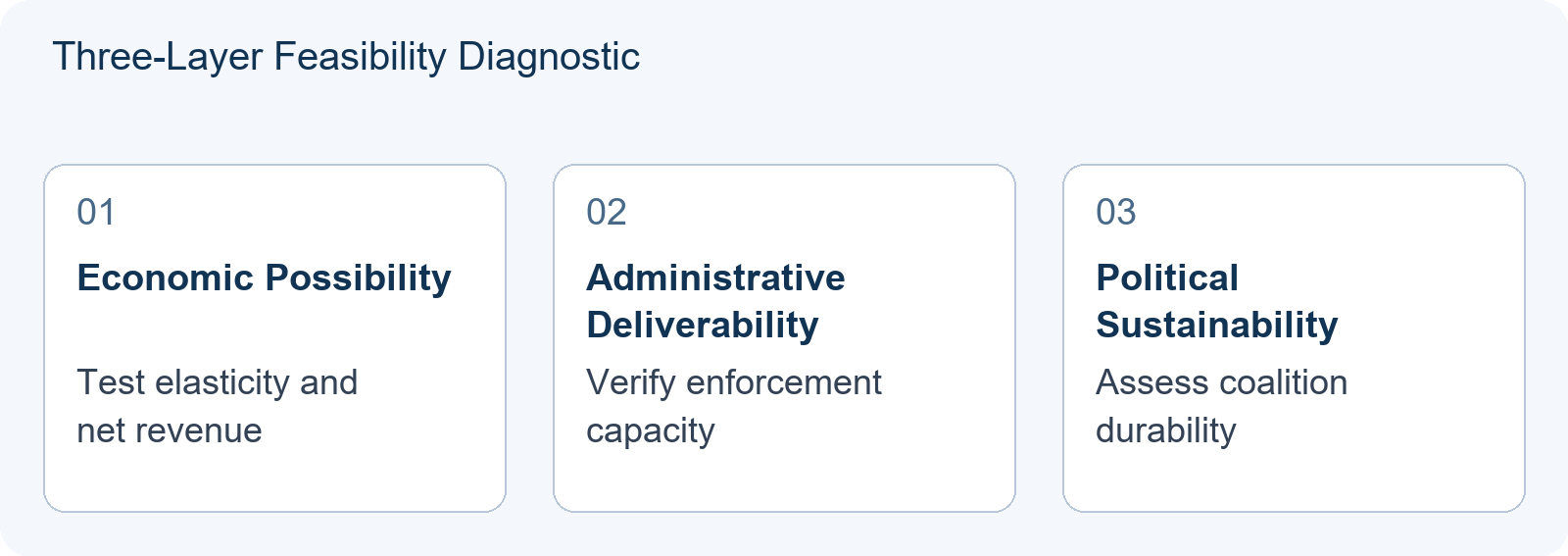
Layer 1: Economic Possibility — Elasticity and Revenue Response
Economic possibility asks whether the mechanism produces its intended effect without collapsing under behavioural response. For top-1% taxation, the critical variable is often elasticity of taxable income. If high earners respond to marginal rate increases by reducing reported income, shifting compensation into capital gains, using trusts, or relocating, the revenue yield may fall below projections even if the statutory rate rises. This is not a moral question; it is a mechanical one.
A serious possibility claim therefore identifies the behavioural channel most likely to activate and explains why it matters. The LSESU Essay Elasticity Check: Test Your Policy Conclusion is useful here: state the relevant elasticity, estimate its direction and rough magnitude from empirical literature, and then ask whether the net fiscal outcome remains positive. Do not simply assert that “rich people will avoid tax.” Explain through which margin they avoid, how quickly, and with what consequence for revenue and distribution.
Economic possibility also includes second-order effects. A tax change can alter investment, firm location, wage bargaining, or the form of compensation. A strong essay does not need to model every channel. It needs to select the channel that most threatens the policy’s stated objective and show whether the threat is large enough to change the conclusion.
Layer 2: Administrative Deliverability — Enforcement and Avoidance
Administrative feasibility concerns whether the state can actually collect what the law demands. Top-1% taxation faces enforcement challenges because wealth and income are mobile, income sources are complex, and verification may require cross-jurisdictional cooperation. Payroll withholding is relatively mechanical because employers report and remit tax, but capital-based taxation depends more heavily on reporting accuracy and audit capacity.
Ask concrete questions. Does the tax authority possess the technical infrastructure to detect evasion at this level? Are there legal loopholes that make compliance optional rather than mandatory? Can third-party reporting be extended to the relevant income sources? Historical and comparative cases often differ because administrative capacity differs, not because the economic logic of taxation changes. This is where the LSESU Essay Mechanism Chain: Link Policy to Outcome helps: trace each step from legislation to assessment to collection to enforcement, then identify where the chain is most likely to break.
Administrative feasibility is not a minor add-on. A policy that is economically elegant but uncollectable is not “possible” in the ordinary policy sense. Even if the law passes, the real incidence may fall on compliant taxpayers rather than the intended top 1%.
Layer 3: Political Sustainability — Coalitions and Time Horizons
A policy may be economically sound and administratively executable yet fail politically. Political feasibility examines whether supporting coalitions can maintain power long enough for the policy to take effect, and whether opposition mobilisation will trigger reversal. Top-1% taxation typically faces concentrated opposition from wealthy donors and diffuse support from beneficiaries. The time horizon matters because short-term electoral costs may outweigh long-term distributional gains.
Use a time-horizon distinction: immediate political backlash, medium-term institutional adaptation, and long-run credibility. If investors and high earners believe the tax will be reversed, their behavioural response may be weaker or stronger depending on timing. If voters doubt the government’s commitment to sustain the policy, the policy may fail before it is fully implemented. Political sustainability is therefore not a separate essay topic; it is a constraint that feeds back into economic possibility.
This layer also gives you a natural place to engage opposing views. The Critical Engagement Is 15 Marks: How to Argue Against Your Own Case in the LSESU Essay (2026) requires you to state the strongest objection, not a weak version of it. For Q4, the strongest objection may not be “taxes are bad.” It may be that raising top marginal rates in a small open economy accelerates relocation of taxable activity, eroding the base and shifting the burden.

Teaching Illustration: Applying the Three-Layer Test to Q4
This is a labelled teaching illustration, not an actual contest submission or official scoring guidance. Consider a hypothetical student argument: “Raising top-1% taxation is possible and desirable because it funds public services.” Under the three-layer test, this answer fails on multiple fronts. Economic possibility is untested because no behavioural response or revenue estimate appears. Administrative deliverability is assumed because no enforcement mechanism is discussed. Political sustainability is ignored because no coalition or reversal risk is considered. Only desirability is asserted normatively.
A stronger version would separate the claims. First, it would establish that revenue projections account for behavioural response, perhaps by discussing taxable income elasticity and the difference between statutory and effective rates. Second, it would show that existing audit frameworks can verify the relevant income sources, or explain what new reporting would be required. Third, it would argue that broad-based public support can offset organised opposition, or concede that the policy is politically fragile. Only then would it assess whether the resulting distribution aligns with the student’s chosen welfare criterion.
Notice what this revised version does not do. It does not claim that top-1% taxation definitely works or definitely fails. It makes the conditions explicit. That is what the prompt asks for. “Possible” becomes a conditional statement: possible if enforcement capacity is sufficient, if elasticity is below a certain range, and if political support survives an election cycle. “Desirable” becomes a normative statement: desirable according to a specified standard such as vertical equity, revenue adequacy, or long-run growth.
Evidence Map: Matching Proof to Layer
| Feasibility layer | Question to answer | Evidence that fits |
|---|---|---|
| Economic possibility | Does the policy produce its stated effect after behavioural response? | Elasticity estimates, revenue simulations, tax incidence studies |
| Administrative deliverability | Can the state assess, collect and enforce the tax? | Comparative tax administration cases, audit capacity data, reporting rules |
| Political sustainability | Can the supporting coalition survive opposition and time? | Coalition analysis, election timing, historical durability of similar taxes |
| Desirability | Is the resulting outcome normatively good? | Explicit welfare criteria, distributional judgments, trade-offs |
Diagnostic: Labelling Every Paragraph as Possibility, Desirability or Neither
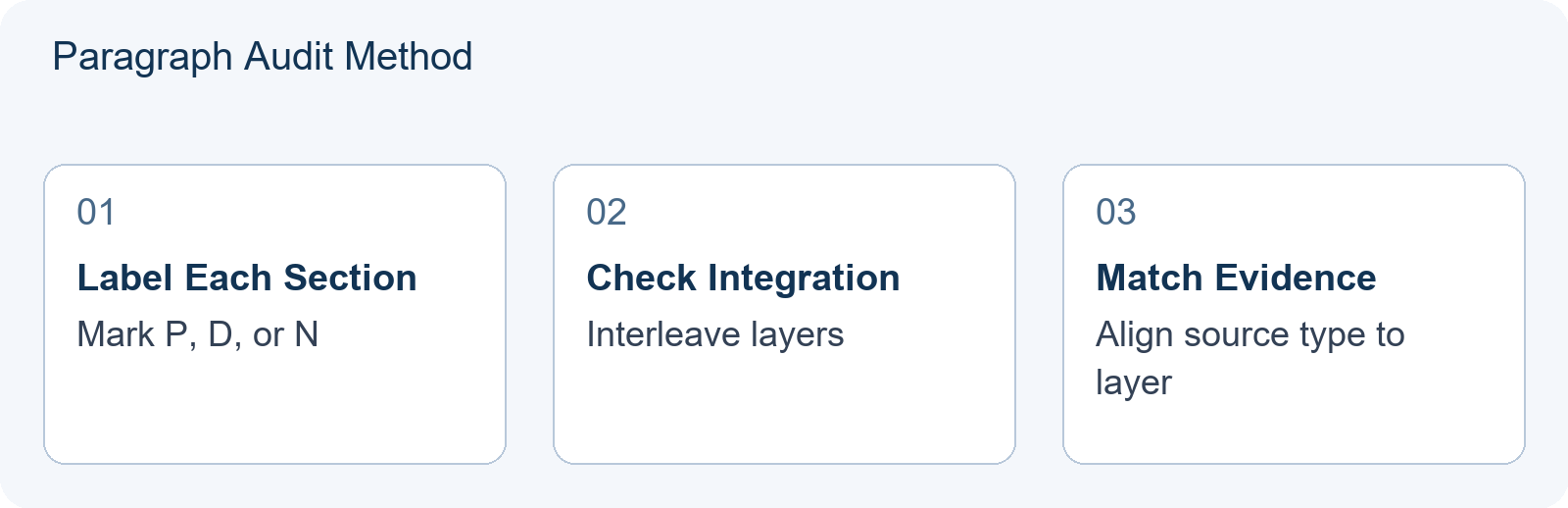
Before submitting, perform a paragraph-level audit. Assign each substantive paragraph one of three labels: P for possibility, D for desirability, or N for neither. If several paragraphs are N, your essay may lack analytical focus. If all P paragraphs precede all D paragraphs without integration, you may have written two separate essays rather than one argument. The stronger structure interleaves them: present a feasibility constraint, then evaluate whether overcoming it makes the policy desirable, or vice versa.
This diagnostic transfers across prompts. Question 3 asks what measures should be put in place to limit AI-driven inequality. That wording also requires implementation feasibility, not just desirability. Apply the same three-layer test to each proposed measure rather than to a single policy. For a regulatory measure, administrative deliverability may deserve more emphasis. For a fiscal measure, economic possibility may dominate. For any measure, political sustainability shapes whether it survives long enough to matter.
Common Failure Modes and How to Correct Them
| Failure mode | Symptom | Correction strategy |
|---|---|---|
| Conflation | Treating “possible” as equivalent to “desirable” without distinguishing layers | Use separate headings for economic, administrative and political feasibility |
| Normative drift | Arguing desirability from values while ignoring implementation constraints | Add at least one feasibility caveat to each desirability claim |
| Evidence mismatch | Using abstract theory for administrative questions or anecdotes for economic ones | Match evidence type to layer: elasticities for economic, cases for administrative, coalitions for political |
| Static assumption | Assuming behavioural responses remain fixed over time | Apply a time-horizon distinction to show dynamic adjustment |
Interpreting the Three-Layer Test: From Diagnosis to Draft
The teaching illustration above shows a common failure mode: conflating desirability with possibility. To turn this diagnostic into actionable writing, you must explicitly label each paragraph’s function. If a paragraph argues that top-1% taxation funds public services, it is a Desirability (D) claim. If it argues that high earners will shift income to capital gains, it is an Economic Possibility (P) claim. If it argues that the tax authority lacks audit capacity, it is an Administrative Possibility (P) claim.
Diagnostic Exercise: Take your current draft. Highlight every sentence in one of three colors: Blue for Desirability, Green for Economic/Administrative/Political Possibility, and Red for Neither (background or definition). If more than 30% of your substantive sentences are Red, you lack analytical focus. If all Blue sentences appear before all Green sentences without integration, you have written two separate essays rather than one argument.
Next Practice Task: Rewrite one paragraph from your draft so that it interleaves P and D. For example, instead of stating “Taxing the rich is fair” (D) followed by “Rich people avoid taxes” (P), write: “While vertical equity supports taxing the rich (D), the policy’s viability depends on whether behavioural responses erode the base (P).” This forces the reader to see the trade-off immediately. Use the LSESU Essay Elasticity Check: Test Your Policy Conclusion to ensure your P claims are mechanically grounded, not just asserted.
Frequently Asked Questions
Does the LSESU Q4 prompt require equal word count for possibility and desirability?
No published rule requires equal treatment. Focus on making both parts explicit rather than matching word counts. The official rubric awards 15 marks for Critical Analysis and asks about engagement with opposing views, trade-offs, limitations and alternative explanations, so an answer that addresses only one half can leave marks on the table.
Can I use the same feasibility framework for Question 3?
Yes, with adaptation. Question 3 asks what measures should be put in place to limit AI-driven inequality, which implicitly requires implementation feasibility. Apply the three-layer test to each proposed measure rather than to a single policy, ensuring administrative deliverability receives emphasis given the regulatory nature of the question.
Is political feasibility outside economics scope?
No. The official rubric awards marks for engaging with opposing views and alternative explanations. Political sustainability can be treated as an economic constraint when it affects policy credibility, behavioural response or long-run equilibrium outcomes. Excluding it may weaken Critical Analysis scores.