LSESU Essay Word Count: What to Add When Your Draft Is Under 1,000 Words
Short answer. The LSESU essay word count question starts with a diagnosis: a draft under 1,000 words may be missing argumentative work, not adjectives. According to competition information recorded in Hanlin International Education’s LSESU site project note (updated 27 August 2026), the essay is in English and no more than 1,500 words, submitted directly to the official portal without prior registration. The same note records a 100-point rubric with 25 marks for originality and 15 for critical engagement. The 2026 cycle closed on 1 September 2026 at 23:59 GMT+1, and submitted entries cannot be modified or replaced. Those weights do not create a word target, but they explain why a short draft should be deepened with mechanism, objection, evidence and distribution rather than stretched with background. This is an independent Hanlin International Education preparation article; it is not the official competition website and does not speak for the LSESU Economics Society or the LSE Students’ Union.
What an under-length draft is telling you
Word count is a symptom. A 900-word draft may be complete if every paragraph does argumentative work; a 1,400-word draft may still be thin if it repeats the same point in different vocabulary. The useful question is not ‘How do I reach 1,500?’ but ‘Which component of the argument has no work in it yet?’ The four-part diagnostic below is deliberately narrow: mechanism, counterargument, evidence test, and distribution over time. It is not a template for every LSESU question, but it targets one failure that can make a short draft look finished when it is not.
| Symptom in a thin draft | Likely missing work | Expansion move |
|---|---|---|
| Policy named, outcome asserted | Mechanism | Add two behavioural responses and one market adjustment |
| One-sided case | Counterargument | State the strongest objection and answer it with a condition |
| Statistics listed in a row | Evidence test | Attach each figure to a claim and ask ‘compared with what?’ |
| ‘Everyone benefits’ | Distribution and time | Separate gainers and losers, and short run from long run |
If the table produces a clear gap, add that gap. If it produces no gap, the draft may simply be concise; do not inflate it.
Diagnostic 1: Can you trace the policy to the outcome?
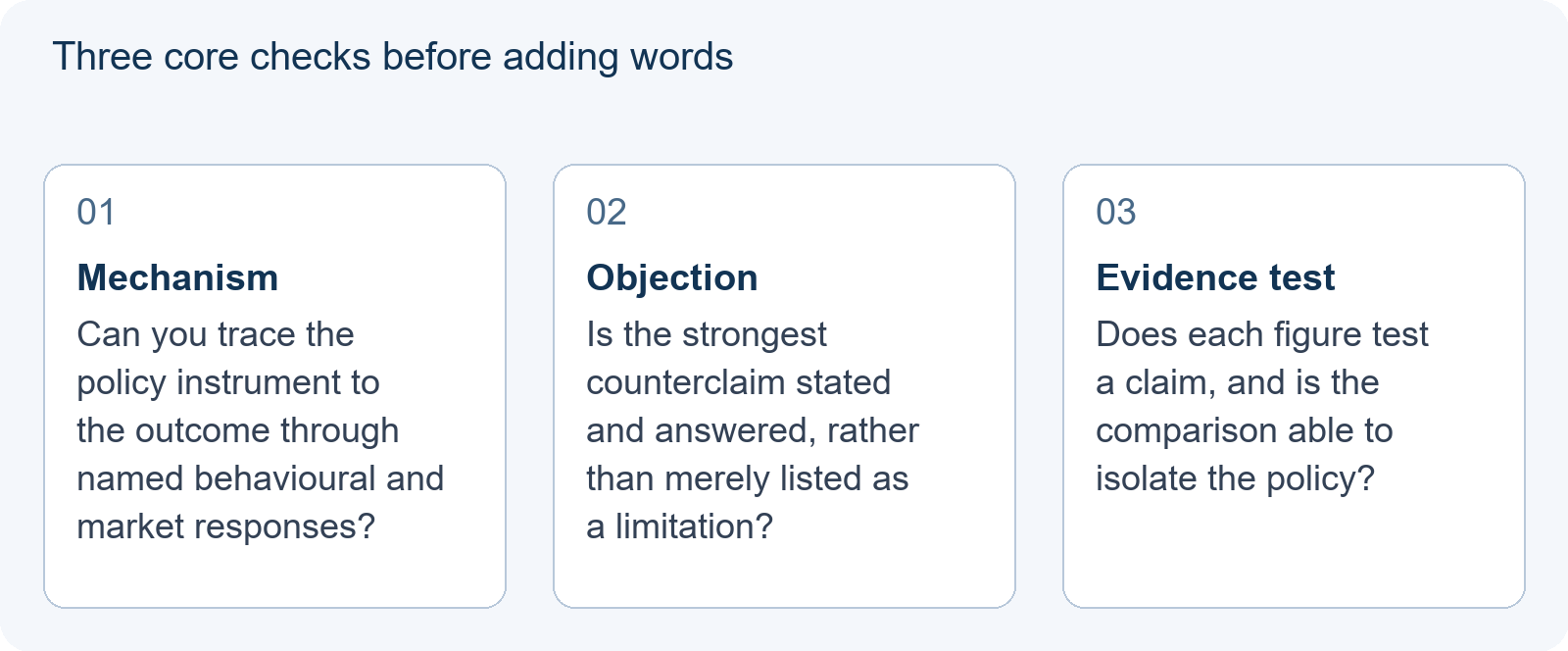
A mechanism is the chain between the instrument and the result the question cares about. If the draft says ‘a tax will reduce consumption’, ask: whose marginal cost rises, by how much relative to substitutes, what do firms do in response, and which measured outcome changes? A useful test is to draw four boxes and three arrows. If two arrows are missing, the paragraph is an assertion, not an argument.
In the abstract: a charge on a harmful activity raises its relative price; some households switch to a substitute, some firms change production, and the size of the effect depends on elasticities and the availability of alternatives. That sentence is still general, but it gives the reader something to test. For a fuller method, see LSESU Essay Mechanism Chain: Link Policy to Outcome.
Diagnostic 2: Do you answer the strongest objection?
A limitation is not a counterargument. ‘Some people may disagree’ is a limitation. The strongest objection states the best reason the policy could fail or be unjust, then answers it. In an essay, that usually means granting the objection’s strongest condition, showing what would have to be true for it to bite, and explaining whether the policy design can meet that condition.
For example, if the draft argues for a congestion charge, the strongest objection is not ‘drivers dislike charges’. It is that the charge may be regressive and may fail to reduce traffic if public transport is weak. A serious answer does not deny the objection; it specifies a targeted rebate, a transit investment, or a phased introduction, and then admits the remaining trade-off. That is critical engagement, not a list of pros and cons.
Diagnostic 3: Does each statistic test a claim?
A short draft may contain a row of statistics that never touch the argument. A figure should answer a question the essay has already raised. If the draft claims that a policy reduces traffic, the relevant evidence is a comparison designed to isolate the policy from other changes: a treated-versus-untreated comparison, a difference-in-differences design, or a credible natural experiment. A simple before-and-after drop is weaker because a fuel-price rise or a recession may explain the change. If the draft merely says ‘traffic fell after the charge’, the reader cannot tell whether the charge did the work.
A practical rule: every statistic gets a sentence beginning ‘This matters because it tests whether…’ If that sentence cannot be written, the statistic is background. For a fuller treatment, see LSESU Essay Evidence Selection: Use a Statistic to Test an Argument.

Diagnostic 4: Have you separated winners, losers and time?
A policy that raises total welfare can still be contested because the gains and losses are uneven. A thin draft may say ‘society benefits’ without saying who pays. The missing move is distributional: identify the groups, the incidence of the cost, and whether compensation is feasible. The second missing move is time: an immediate effect may differ from a long-run adjustment as people change routes, investment or expectations.
For example, a congestion charge may reduce traffic in the short run, but in the long run it can change where people live and work. The short-run winners may be commuters who value time; the short-run losers may be drivers with no substitute. A good paragraph does not need a full incidence model, but it must not pretend that ‘the city’ is a single person. Separate the groups and the time horizon before adding more policy detail.
Worked hypothetical: a 900-word congestion-charge draft
Teaching illustration. This is a hypothetical student draft, not an official LSESU prompt, not a real submission, and not scoring guidance. Imagine a 900-word draft arguing that a city should adopt a congestion charge. It says traffic is bad, cites one congestion figure, mentions that other cities have tried similar policies, notes that low-income drivers may suffer, and concludes that the charge is desirable. The prose is clear, but the argument is thin. Three expansion moves add substance.
Move 1: Add a mechanism, not a slogan
The draft currently says ‘charges work’. Replace that with a chain: the charge raises the marginal cost of driving into the zone; drivers with flexible routes and good transit may switch; drivers with fixed trips may pay; revenue can fund bus frequency; the traffic effect depends on demand elasticity and transit capacity. This does not add a new topic. It explains the existing claim.
Move 2: State the strongest objection and answer it
The strongest objection is not ‘drivers will complain’. It is that a flat charge may take a larger share of income from poor drivers and may not reduce traffic if alternatives are poor. The draft can answer by proposing a targeted lump-sum rebate and a transit condition, then admit the residual trade-off: if the rebate is paid from charge revenue, less money is available for transit; if the rebate is linked to driving, the traffic signal weakens; if there is no rebate, the fairness case weakens. That is a real argument, not a limitation paragraph.
Move 3: Attach evidence to the claim
The draft’s congestion figure should test the mechanism. Ask: compared with what? If the figure is a simple before-and-after drop, it cannot separate the charge from a fuel-price rise or a recession. If the draft uses a comparison with a similar city that did not adopt the charge, and the two cities had similar pre-charge trends, it can support a causal sentence. The point is not to add more numbers; it is to make one number do argumentative work.
After these moves, the draft may be longer because it has more work to do. It should not be padded to a round number. The test is whether a reader can now trace the policy to an outcome, name the strongest objection, and see what evidence would change the conclusion.
What not to add
- Definitions. A definition of congestion is useful only if the question turns on measurement. Otherwise it delays the argument.
- History. A paragraph on the first congestion charge can be interesting, but it is not a substitute for mechanism.
- Long quotations. A quotation should be doing analytical work; if it merely restates the point, cut it.
- A second question. Do not import a new policy area to reach a word count. That creates a second thin essay.
- Repeated examples. Three examples of the same mechanism are usually one example plus two restatements.
The opposite problem is also real: if the draft is over 1,500 words, the task is compression, not expansion. The sentence-level clinic for an over-length draft is a different job; see Cutting to 1,500 Words: A Sentence-Level Compression Clinic for the Final Week (2026).
A 45-minute revision order and a stop rule
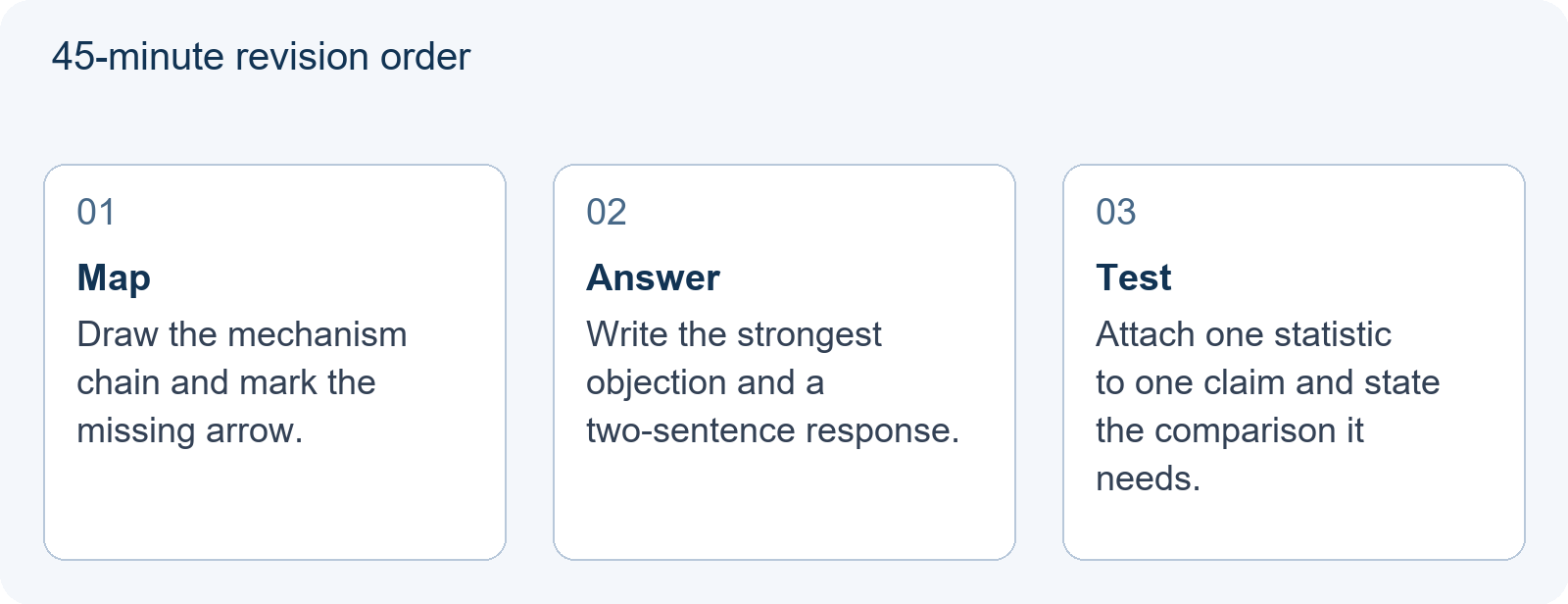
If the diagnostic leaves you with several gaps, do not fix them in the order they appear. Use 45 minutes as follows. Minutes 1-10: draw the mechanism chain and mark the missing arrow. Minutes 11-20: write the strongest objection in one sentence and the answer in two. Minutes 21-30: choose one statistic and write the comparison it needs. Minutes 31-40: add one distributional sentence and one time-horizon sentence. Minutes 41-45: read the new paragraphs aloud and delete any sentence that only announces what you will argue.
The stop rule: every added paragraph must do one of four jobs: explain a mechanism, answer an objection, interpret evidence, or separate distribution and time. If a paragraph does none of these, it is padding. If two paragraphs do the same job, merge them. A draft is deep enough to edit when a reader can state your causal chain, your best objection, and the condition under which your conclusion would fail.
If you ask a teacher or coach for a second read, bring that one-page map rather than the question ‘How do I make this longer?’ A reviewer can test a mechanism or an objection; a reviewer cannot invent your argument for you. The useful request is specific: ‘Is this chain missing a behavioural response?’ or ‘Have I answered the strongest objection or only listed it?’
Finally, separate the 2026 cycle from future preparation. The 2026 window closed on 1 September 2026 at 23:59 GMT+1, and submitted entries cannot be modified or replaced. For a later cycle, check the official competition site for the current rules before relying on any word-count or submission detail. The drafting lesson survives the deadline: a short draft becomes stronger when it adds argumentative work, not when it adds words.
General event background is available at Event background.
Frequently Asked Questions
Is a 900-word LSESU essay automatically too short?
The supplied 2026 rules state a maximum of 1,500 words and no stated minimum. A 900-word draft is within that maximum, but it still needs a complete argument. If the mechanism, strongest objection, evidence test and distributional effects are missing, the problem is depth, not word count.
What should I add first: more evidence or more theory?
Add the missing mechanism or objection first. Evidence is most useful when it tests a specific link in the argument; adding statistics before the claim is clear produces background, not analysis.
Can I revise an essay after submitting it?
The 2026 rules recorded in the source note say submitted entries cannot be modified or replaced. For a future cycle, check the official competition site before relying on that detail.